


Lenco Celebrates $5M in Capital Investments
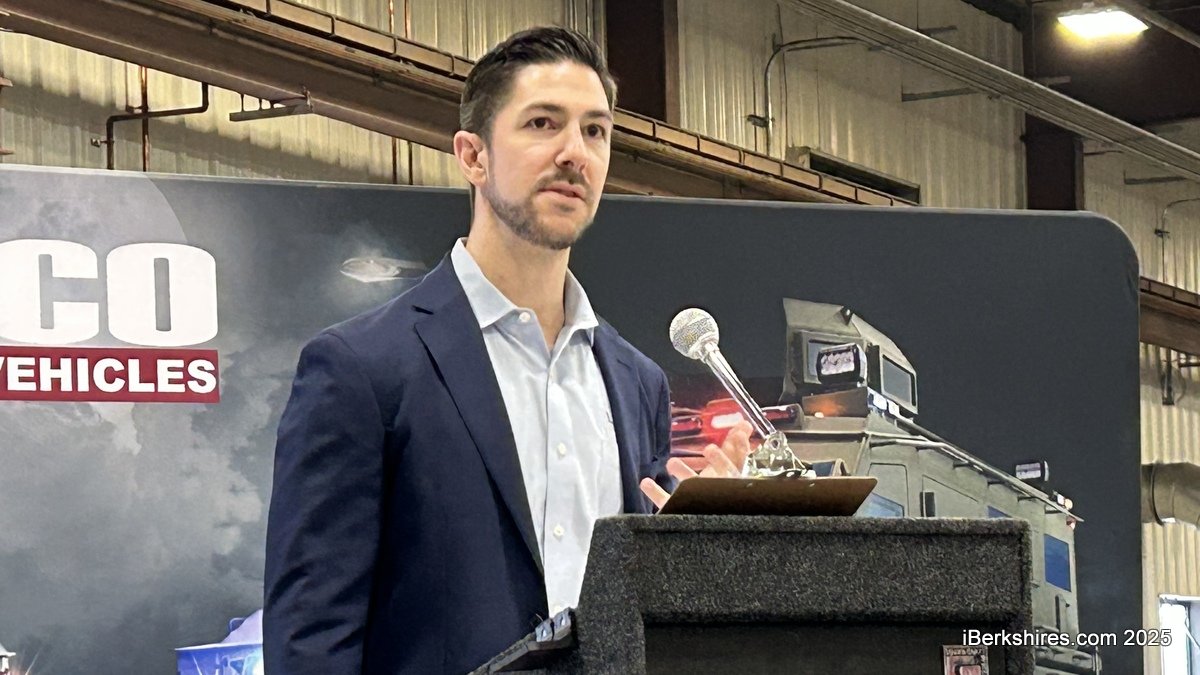
Executive Vice President Lenny Light says it's not the equipment but the staff that gives Lenco its competitive advantage.
A ribbon was cut on Monday in front of the company's new Trumpf TruLaser 3080, a machine designed to cut extra-large sheets of metal. This will increase the efficiency of building armored tactical vehicles, such as the BearCat, by about 40 percent.
Executive Vice President Lenny Light recalled the Lenco's beginnings in 1981, when it operated out of 3,000 square feet on Merrill Road with 15 employees. Today, Lenco has 170,000 square feet of manufacturing space and nearly 150 employees.
"The work that we do here in Pittsfield contributes to millions of dollars being put back into our local economy. We're the largest commercial armored rescue vehicle manufacturer in the United States. We're one of the most respected brands locally. We also now own the largest fiber laser in the United States. It's the only one of its kind in the Northeast," he said, motioning to the massive, modern machinery.
"But the equipment that we have is not our competitive advantage — our welders, our forklifts, our cranes — any company can buy this same exact equipment."
Rather than the equipment, he said, it's the staff who shows up every day with a can-do attitude that gives Lenco its competitive advantage.
Planning for the industrial cutter began 18 months ago, when the company needed to decide if it was the right equipment for the future. Trumpf, named for its founder, is a German-headquartered global manufacturer of high-end metal processing (computer numerical control) machines, including laser technology. The TruLaser 3080 uses a high-intensity laser beam to cut through metals with speed and accuracy.
Over several months, a 12-page research paper was compiled about how the Trumpf machine could benefit production, and Light said it was "very clear" that it would make Lenco faster, higher quality, and more innovative.
It cuts material 300 percent faster than the old machine, and is expected to make overall production an average of 20 to 30 percent faster when fully integrated. There were more than 3,000 parts that had to be redesigned for the machine, and until last week, the production space was being rearranged to accommodate the flow of material.
The machine cost nearly $2 million, and the company received a $200,000 grant from the Massachusetts Technology Collaborative for the effort.
Lily Fitzgerald, director of MassTech's Center for Advanced Manufacturing, said the state is unique for having a team dedicated to supporting manufacturing. Massachusetts has 6,000 manufacturers, and the sector contributes 10 percent and growing of its Gross Domestic Product.
"There is so much of manufacturing that is unseen and underappreciated. I love coming to Pittsfield because I know that that's not true in this town," she said.
"This town understands the power of this industry, because you live and you breathe it every day."
Funds were awarded through the Massachusetts Manufacturing Accelerator Program, which helps manufacturers scale up, modernize, automate, and meet customer demand. Fitzgerald said she wishes every company came to her office with a 12-page plan on how to leverage a piece of equipment and make sure it is the best use for taxpayer dollars.
"You're best in class for that," she said.
Light said the program, in a way, inspired Lenco officials to think big, and what started as about a half-million dollar investment in welding equipment turned into a $3 million investment in advanced CNC technology.
His father, President and CEO Len Light, remembers when the steel was cut with oxyacetylene torches and is pleased to see the advances in technology. This project fills him with confidence that the company's future is good, and he hopes this investment demonstrates its commitment to continuous improvement in manufacturing and product quality.
"We got our first Hypertherm handheld plasma cutter in the mid-80s, which was when it was invented. Some of you weren't even born at that time," he said.
"We've come a long way since then, and I can't be proud enough of our next generation of leadership who spearheaded this project and successfully executed its implementation that we're celebrating here today."
Light added that the BearCat (Ballistic Engineered Armored Response Counter Attack Truck) is a proven vehicle that saves lives. Lenco has good reason to celebrate, as it is busier than ever and will be able to meet increasing BearCat demand with these improvements.
Berkshire Innovation Center Executive Director Benjamin Sosne said he sees evolution every time he visits the Betnr Industrial Drive facility and credited the Lenco team for being committed to improvement and efficiency. He tells young startups coming into the BIC about the origins of the BearCat, and says, "Look at Lenco now."
He commended the company for leveraging state resources to upgrade equipment.
"You didn't just go out and buy something. You really thought through what was going to be a long-term solution and long-term growth for the company, and it ended up much bigger than you originally started," Sosne said.
Tags: Lenco, manufacturing, ribbon cutting,


