


Mobile Museum of Tolerance Comes to Massachusetts
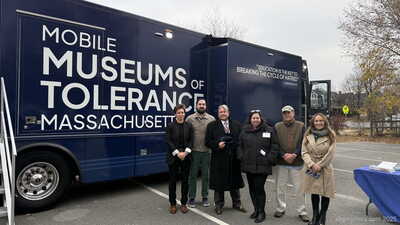 |
| Melissa Mott, Brian Strafach, Timothy Shugrue, Jewish Federation Executive Director Dara Kaufman, William Ballen, Berk 12 coordinator of professional development, and Joann Shugrue, Rep. Richard Neil Staff Assistant |
PITTSFIELD, Mass. — The Simon Wiesenthal Center's Mobile Museum of Tolerance advocates for education as a means to address the rising levels of hate and division observed nationally over the past two years.
Melissa Mott, Simon Wiesenthal Center's executive vice president of education programs and strategies said the museum is a free, traveling education center fully funded by the state legislature as part of a $61.47 billion fiscal year 2026 budget, which included funding for education filed by Rep. Ken Gordon.
Of that, $875,000 went to adding the Simon Wiesenthal Center's Mobile Museum of Tolerance Bus to Massachusetts.
"Students want to do something to make their world better, and they really do. They are looking for connection with each other, Mott said. "And they're looking for a place and a space in which to talk about the issues that are impacting them on an everyday basis, whether that's in the broader social, political climate, or whether that's just an issue that they're having within the classroom or the school."
She said the program was implemented four years ago, with the first bus opening in Illinois. It has expanded to California, Florida, New York, and now Massachusetts.
She added that the popular program is often booked out two years in some states.
In partnership with the Jewish Federation of the Berkshires and Berk12, the Tolerance Museum's first stop is Berkshire County.
Since its inception its buses have traveled more that 66,000 miles, to more than 120,000 students in grades five through 12.
"The museum wants to help students build community by demonstrating that their peers want to do the same. They also want students to discuss historical issues and what they mean today, said Brian Strafach, associate educator at the New York Mobile Museum."
He added that students are microcosms of what is going on in their greater community, neighborhoods, towns and states.
Strafach said they want students to be civically engaged. On the bus, students are encouraged to “start small” with the differences that they are making. They are then encouraged to form the habits that they want to carry with them to college, their careers, or wherever they end up after school.
"We focus mainly on history, so that we can see patterns today, so that students can see that there are so many role models for us to follow from the past when it comes to resistance, when it comes to standing up for ourselves, for our community," he said.
"And so we want students to understand that history is not something that they look in, but they are actively participating in history and in the future by following these examples of upstanders during the Civil Rights Movement, upstanders to the Holocaust."
Strafach said they collect student and teacher input so they can cater its programming to the area.
"One of the most fun parts of being a traveling educator is getting to meet so many different communities and find out what makes them special, what they are proud of, and what makes them individuals that we can really emphasize," he said.
The 30-seat wheelchair-accessible field trip experience offers immersive technology to facilitate dialogue. Workshops are tailored to various ages, focusing on topics such as antisemitism and hate, the Holocaust, the Civil Rights Movement, and decoding online hate.
Part of its organization is a two time Oscar award winning media company that creates short films to enhance the learning experience.
Workshops include "The Anne Frank Story: A Voice of Hope," “Combat Hate (Digital Media Literacy Workshop)," "The Power of Ordinary People" and "Civil Rights."
Recently, the organization shifted its curriculum to include resistance, Mott said.
"Our existing programs are incredibly popular, but we have a responsibility to change with the changing times. Hatred and anti semitism and extremism, they are always changing and shifting and mutating, and so in order to actually make educational interventions that are impactful, we have to be prepared to constantly be addressing the landscape," she said.
The mobile museum now showcases stories of resistance to highlight more of an emotional response, Mott said.
She said the concept of resistance does not have to imply violence, noting that it can also refer to spiritual and cultural acts. The museum focuses on helping students build and feel their own agency in hard times and on realizing when the living climate or their rights are antithetical.
Mott added that they also want students to understand how feelings influence perceptions, beliefs, and actions.
"Hopefully, it will help them see themselves in history, but also see themselves as important components and contributors to history. That we are not sort of independent actors here. Everything that we do is a historical action. We're always contributing to what we read in textbooks,
"The people who we read about in those textbooks were just regular people like us. And my hope is that we can help students to situate themselves in history, to show them that what they do matters all of the time, not just in a particular, given, difficult moment."
District Attorney Timothy Shugrue discussed recent incidents of hate in schools over the last two years, including anti-Semitic graffiti in Great Barrington and Dalton.
"I think there's been a lack of civility. I think that's a big problem in the country right now," he said.
The internet has enabled people to say whatever they want and not have any recourse from it, Shugrue said.
"I think the state of hatred has really grown in the last few years, so we have to educate and stop that tide. We're doing that by getting the schools to teach the kids young," he said.
Shugrue highlighted how he opened the Children's Advocacy Center in 1995, which demonstrated how the county has got so many people that are generous, that will give their time and money to invest in these types of programs.
Tags: museum,


