image description
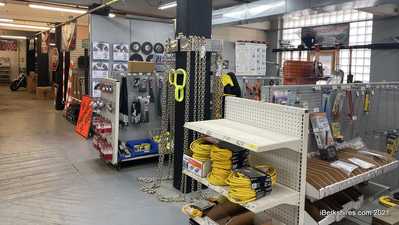
RIBCO sells a line of snow plows, snow blowers, and power equipment and drainage and sewer supplies.
image description
R.I. Baker offers a range of welding, metal fabrication and machinery repair.
image description
The company is situated in an old mill in Clarksburg.
image description
RIBCO has locations in Clarksburg on River Road and in Pittsfield.
image description
RIBCO sells outdoor power equipment and offers seasonal storage for winter equipment.
image description
image description
RIBCO is located at 537 Dalton Ave. in Pittsfield.

R.I. Baker, RIBCO Servicing Berkshires and Beyond Since 1938
Print Story | Email Story

Tom Pelczysnki runs both R.I. Baker and RIBCO, locally grown businesses headquartered in Clarksburg. 
CLARKSBURG, Mass. — Nestled in an old wool mill on River Road is a pair of Berkshire County-grown businesses that are still thriving after nearly 80 years in business. 
 
RIBCO Supply, which grew out of its neighbor R.I. Baker, sells outdoor power equipment, drainage and sewer supplies, snow blowers, snow plows and municipal supplies, among other things. Its neighbor is R.I. Baker Co., a commercial metal fabrication and certified welding company that began in 1938. The latter also does pipe fitting, plumbing equipment, and machining.
 
R.I. Baker was started by Russell Baker as a small plumbing shop that operated out of Baker's garage. Eventually, Baker moved his business to its current location and took up millwright services, metal fabrication, and certified welding.
 
Now, Tom Pelczynski runs the business, as well as RIBCO next door. According to Pelczynski, RIBCO started out of necessity. Contractors would come to R.I. Baker and ask if they sold supplies. At the time, they did not, but in the mid-1970s, R.I. Baker expanded and opened up RIBCO to cater to these customers.
 
Readers may not have heard of R.I. Baker before, but will recognize some of the entities that it does business with: SABIC in Pittsfield, for instance, employs an R.I. Baker millwright and Williams College and Specialty Minerals both bring their large machinery to Clarksburg for repairs.
 
"We're a job shop," said Pelczynski, meaning that they don't mass-produce mechanical parts. Rather, when some business needs a specific item fixed or produced, they will come to R.I. Baker to have it looked at. 
 
While R.I. Baker has grown over the years, it is not the behemoth that many may fear. 
 
"We're small enough to be able to change direction, change course," Pelczynski said, and are nimble enough to aid local businesses in a pinch.
 
When R.I. Baker first opened its doors, it drew on many of the businesses in Berkshire County, which included some mills. Over time, however, mills moved away, which prompted a shift in focus toward the more residential/contractor-based RIBCO.
 
RIBCO has a store on Dalton Avenue in Pittsfield, which opened in 2006, and between the two locations the business can service all of Berkshire County. They even cover Southern Vermont and parts of New York.
 
Indeed, RIBCO provided much-needed services to South County throughout the COVID-19 pandemic. When second-homeowners moved to the Berkshires semi-permanently, their septic systems often needed to be repaired because they experienced more stress than normal. RIBCO was able to supply them with the materials they needed from its Pittsfield location.
 
Another invaluable service that RIBCO provides is equipment storage. RIBCO will pick up, repair, and store equipment like lawnmowers and snow blowers. They'll deliver it "all serviced and ready to go." Customers will often store their equipment seasonally; for instance, most people will want to get their snow blowers serviced in the summer.
 
As Pelczynski noted, snow blowers "don't fail when they're sitting there in the summertime." Rather, they break when users need them most. Regular service will ensure that they run smoothly, and RIBCO can keep them that way for a low cost.
 
This focus on customer convenience is part of RIBCO's strategy to bring in more residential customers. Pelczynski wants "Joe Homeowner [to] feel comfortable walking into a RIBCO Supply," whether in Clarksburg or Pittsfield.
 
R.I. Baker services commercial businesses all over Berkshire County and beyond. It has done work for as far away as California, China, and even Indonesia. Despite this sometimes global reach, R.I. Baker is fundamentally a community business. Many of the R.I. Baker welders, fabricators and other skilled workers are recruits from McCann Technical School's co-op program, which serves as "a great feeder program" for the business.
 
RIBCO's website can be found here. It is open Monday through Friday, 7 a.m. to 4:30 p.m. in both Clarksburg and Pittsfield.

View All Business Profiles


Why the Massachusetts Art Community Is Worth Continued Investment

By James BirgeGuest Column
How do we quantify the value of art on society and culture? Even eye-popping figures, like the $100 million estimate for the jewels stolen from the Louvre, or the record auction last fall that saw a piece by Gustav Klimt sell for more than $236 million can't fully account for the value of the history, stories, and emotions behind the creations themselves. But beyond that, there is a measurable financial, cultural and social benefit of the arts that is often taken for granted. 

Closer to home, arts and cultural production in the Commonwealth of Massachusetts totals nearly $30 billion annually, representing more than 4 percent of the state's economic output, according to the Mass Cultural Council. All told, more than 130,000 jobs are spread across the commonwealth creating a vibrant and thriving artistic community for us all to enjoy. 

Despite the obvious impact, these figures are under threat. A recent survey by MassCreative compiled recent federal cuts to the National Endowment for the Arts, the National Endowment for the Humanities and the Institute of Museum and Library Services and identified 63 grants canceled and $4.2 million in grant funding rescinded across New England so far this year. 

The dollars, of course, are important. But they also only scratch the surface on what they bring to the community. Today, we risk losing part of the culture and identity many now take for granted. 

While others choose to look past these less tangible, but just as vital benefits, we're doing the opposite. Massachusetts College of Liberal Arts is all in to ensure the next generation retains their access to works of art, while also being empowered to create themselves. 

Last fall, MCLA officially broke ground on the new Campagna Kleefeld Center for Creativity in the Arts, which will serve as a new hub for the campus and the local community for arts programming. When complete in fall of 2027, our students will benefit, but so will all of Berkshire County and artists in the surrounding area. 

This exciting new facility is just one of the many forthcomings our region can enjoy in the coming years. Just a few miles away, anticipation builds for the Fall 2027 anticipated opening for the Williams College Museum of Art. Years in the making, the museum likewise grows from an enduring commitment to the arts, both in curriculum and in practice. Exciting times are also underway for the Clark Art Institute with the construction of a new facility to house a collection of 331 works of art, including paintings, sculptures, drawings and other works. Their wing is scheduled for completion in 2028. And listeners will no doubt enjoy the sounds and melodies from Mass MoCA Records, the latest endeavor to foster creativity and artistic pursuits through music launched in October as well. Of course, many are also awaiting the reopening of the Berkshire Museum anticipated this summer, after a tremendous renovation process to rejuvenate the experience for visitors. 

So much time, energy, and yes, dollars, have already been invested in taking these facilities from ideas and sketches and making them reality. But they represent much more than new buildings. They represent new opportunities to cultivate and accelerate the thriving arts community in Massachusetts and the northern Berkshires. 

Art, regardless of the medium, is a reflection of who we are, where we've been, and what we aspire to be. It can be inspired by hopes or fears and chronicle collective triumphs as well as tribulations. The goal of art is not only to document history, but to inspire those positioned to change it and to feel something new or even to provoke us to revisit our own assumptions or misconceptions. 

As unfathomable of a number as $30 billion can seem, boiling down the impact to any number inherently discounts the unknowable downstream effects our graduates will bring to the community and the broader world after they leave our institutions. Likewise, rescinding $4.2 million now removes a huge chunk of that growth potential.  

Justification for making these investments today when simply boiled down to dollars and cents still places us on solid ground strictly from a financial perspective that forgoes all of the intangible, but no less valuable, benefits as well.  

The arts are still worth our support. And our community will be richer for it. 

James Birge, PhD, is president of Massachusetts College of Liberal Arts in North Adams.  


View Full Story

More North Adams Stories