
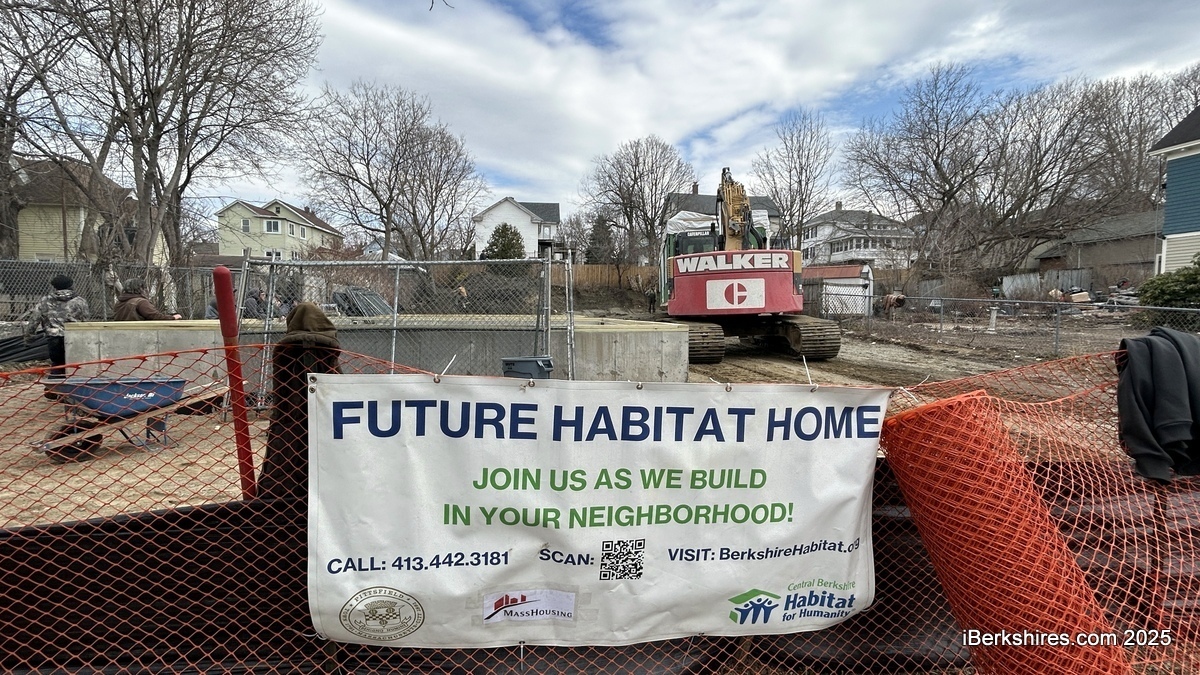
Tariffs Reduce Scope of Habitat for Humanity Housing Project
PITTSFIELD, Mass. — Tariffs have caused Central Berkshire Habitat for Humanity to cut one unit of below-market housing from its ARPA-funded project.
Last week, the Affordable Housing Trust voted to amend the scope of its funding contract with the nonprofit to exclude an accessory dwelling unit. Last year, Habitat was awarded $240,000 in American Rescue Plan Act funds to build six different-sized housing units on Robbins Avenue, Murphy Place, and Curtis Terrace.
The goal is to sell homes to people between 50 percent and 65 percent of the area's median income.
Because of tariffs imposed by the Trump administration, the funding gap nearly tripled. To make the project happen, Habitat had to save nearly $200,000 by cutting the ADU, which is now allowed by right in Massachusetts.
"Originally, our hope was to have five homeownership opportunities and then to be able to test out having an ADU building on one of the lots, probably was going to be Robbins, and what our hope was is that we could test the ADU model," CEO Carolyn Valli said.
"But the biggest challenges that are coming up right now are the new tariffs that went into effect."
For the five units and ADU, Habitat originally expected it to cost a total of nearly $2.2 million with a $116,531 funding gap, but now, that cost has risen by $194,700 and would result in a $311,231 funding gap.
"So now we would have to subsidize that project by $311,231, which is why we're requesting to not have to do the ADU, and the ADU is in the ARPA agreement, so that's what we're looking for, is to be able to remove the ADU," Valli explained.
"I still want to test that theory sometime, but I can't do it when the tariffs are in effect."
The Curtis Terrace build is in partnership with Taconic High School's vocational program, and Valli reported that contractors are not sure how much support they can add to the effort with rising prices.
"So I have to make sure that I can complete those five units of home ownership, rather than testing out a model," she explained.
Right now, a 3-4 bedroom rental costs more than $1,800 per much and requires a salary of about $75,000 per year. With a 20 percent subsidy from Habitat, a person who makes about $61,800 per year can pay just over $1,500 with principal, interest, taxes, insurance, and condo dues if applicable.
Valli spoke about the struggles of navigating subsidized housing, as a person's rent, citing a homeowner the nonprofit worked with, whose payment went from $300 a month to $1,600 a month because she got a second job.
"I really am glad we have subsidized housing for people because sometimes it takes a lot to get a skill set that you can market, get a good job, or all of these different things, but there's got to be room in there for everybody because a lot of people are still being left out of homeownership and wealth generation, and we think that's really important," she said.
She explained that there were "multiple" things they wanted to test with the ADU model. If the ADU rent was low enough, the renter could save up for a down payment on a home, and the revenues coming in could offset the condo association fees.
"That's still the theory I would like to make happen," Valli said.
Director of Community Development Justine Dodds echoed her positivity about building an ADU in the future and recognized that the larger economic situation is unfortunate.
"We have a viable project here, we have funding in place, and these economic decisions that are being made seems very counterintuitive to what we should be doing," she said.
Tags: ARPA, federal funds, habitat for humanity,


