Williamstown Passes Budget, Puts Off Decision on Land Sale
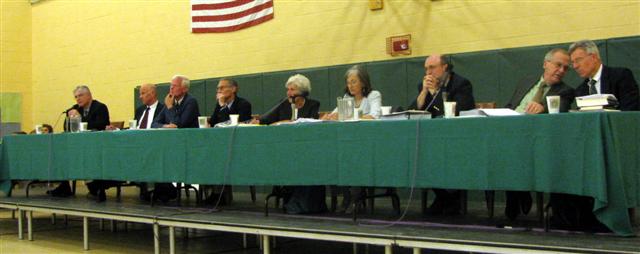
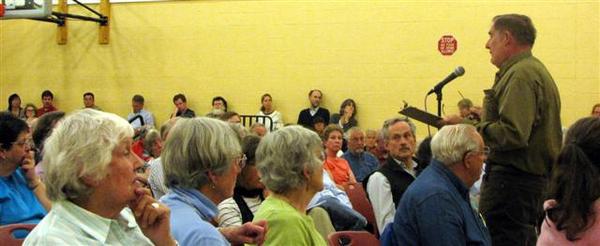
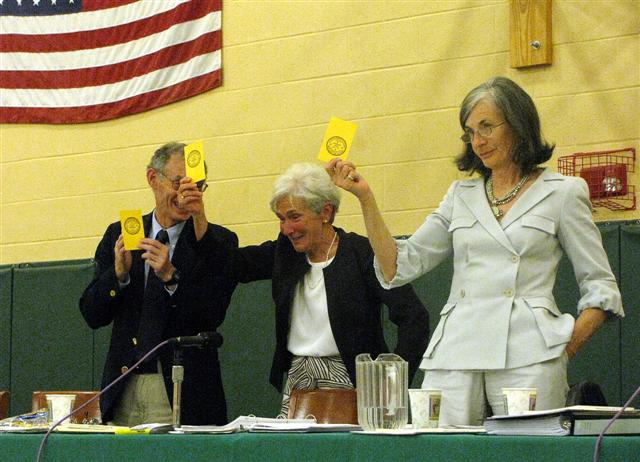  Williamstown voters OK'd 32 warrant articles at Tuesday's town meeting. Top, Selectmen David Rempell and Jane Allen and Finance Committee Chairwoman K. Elaine Neely stand to be counted. Bottom, Wendy Penner addresses the crowd. Williamstown voters OK'd 32 warrant articles at Tuesday's town meeting. Top, Selectmen David Rempell and Jane Allen and Finance Committee Chairwoman K. Elaine Neely stand to be counted. Bottom, Wendy Penner addresses the crowd.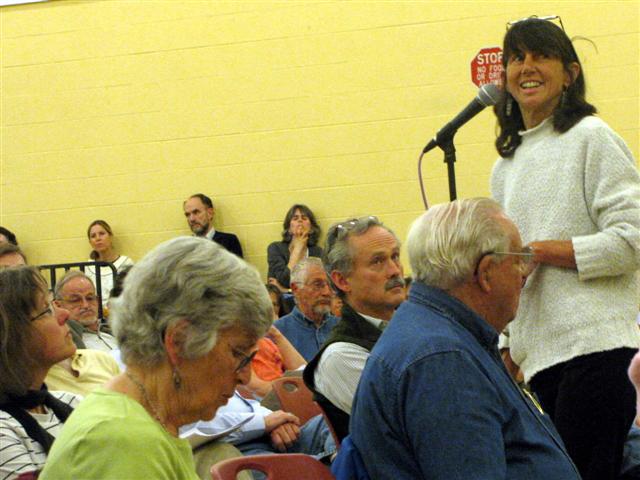 |
With the exception of discussion on the Blair lot, the biggest money articles and potentially divisive questions passed fairly quickly during the nearly three-hour meeting. But, as is wont to happen at these very democratic gatherings, a change in a sign ordinance provoked the most talk — and most calls for votes.
Some 241 voters attended, about half the turnout of last year's meeting when two controversial bylaws were on the warrant.
Town meeting swiftly approved a 2010 budget of $6,126,738, a 1.6 percent increase over last year, and an elementary school budget of $5,261,543, also up 1.6 percent. The Mount Greylock Regional School District assessment of $4,413,109, down 1.9 percent from last year, also passed easily.
Voters also approved several articles that expanded the Village Business District and designated it an economic opportunity area.
Blair Lot
The Selectmen had recommended 3-1 to pursue a sale of the 235-acre Blair lot to the state Division of Fish & Wildlife, with the expectation of making around $1,000 an acre. The steeply sloped lot lies between Routes 7 and 43 and borders Hancock and land already part of a state wildlife management area. It has no road frontage and must be access through state or privately owned land.
Tree Warden Robert McCarthy had vigorously opposed selling off the land because of its potential for lumber and wind power, reasoning he repeated at town meeting.
"If it wasn't for the town having control of this piece of property, I would wholeheartedly like Fish and Wildlife to have it," said McCarthy, who argued the sale wouldn't make up for the loss of the land. "I think the town can do a better job of managing this land."
Patrick Dunlaevy, a Planning Board member, said he had expected to speak against the sale but changed his mind earlier in the day after talking with the developers of the Brodie Mountain wind farm.
That conversation had convinced him that the potential for wind power wouldn't be realized because the Brodie project won't come close enough to the peak to bring the infrastructure necessary to connect turbines to the electrical grid.
"We have the potential to sell this land for $1,000 an acre, we should go for it," he said. "I'm very much in favor of permanently conserving open space."
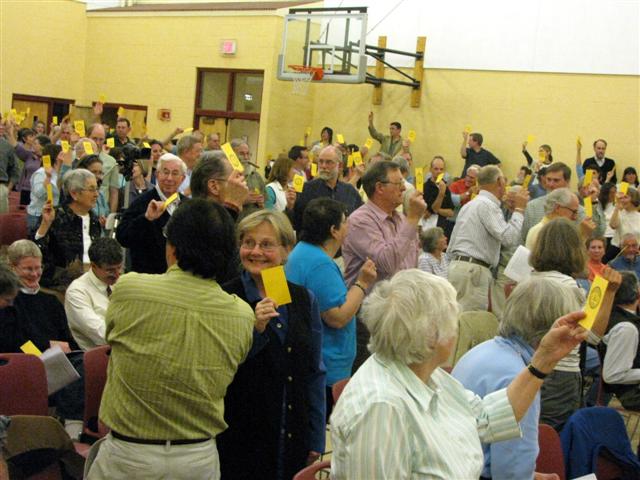 After several speakers addressed the meeting, a motion was made by Nancy Nylen to table the article, which passed by the required two-thirds vote. The voice vote was close enough that Moderator Stanley Parese called for a show of voting cards; the count was 158-32 to table.
The vote effectively killed any possibility of selling the land unless it is brought to another town meeting.
"I'm just an old Yankee but for a piece of land that didn't cost us anything, for a piece of land that we took $60,000 [in lumber] out of 16 years ago, for a potential revenue ... for as long as trees grow, to be able to manage this land the way the town of Williamstown wants to manage and not be told by Big Brother, the state, I think we ought to keep it," said McCarthy.
Sign Bylaw
It took nearly 30 minutes to decide a change in the sign bylaw that would allow two directional signs to be used for sales, rentals and open houses.
Gordon Squires, a former member of the sign commission, motioned to amend the ordinance to greatly limit the use of the signs, including banning them from Main Street and limiting their use to between 9 and 5.
That brought objections from several people, including real estate brokers Paul Harsch and Judy Giamborino.
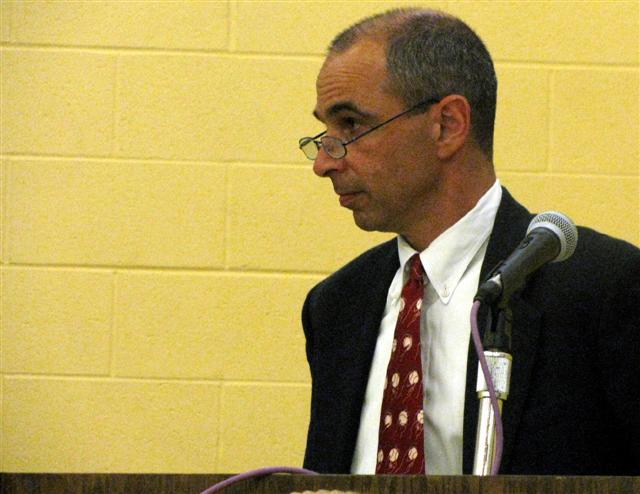 "These signs are for your benefit," Harsch told the audience. "Not for our benefit in particular. I would be careful of overrestricting the language in this bylaw."
Curtis Scott of the Sign Commission said the bylaw had been prompted by requests to allow more than one directional sign (a sign that would direct people from a nearby intersection). Town Manager Peter Fohlin said any signs require his "initials" so the bylaw would not lead to the promulgation of signs all over town.
After a number of people spoke, an attempt was made to table the question, which failed to garner the two-thirds vote required. The question was then called and Squires' amendment was defeated, but questions continued to be raised over the wording of the bylaw in its reference to placing signs at "two road intersections nearest to a house for sale ... ."
Using the home of Margaret and Robert Ware on Moorland Street, Fohlin, Scott and others debated where two signs would go. Robert Ware finally got up and offered another amendment to allow two signs, one of which must be at the intersection closest to the home.
That amendment easily passed on a voice vote and, once again, the question was called. "I think we have talked this issue through enough," said Parese, who declared the amended version passed on the subsequent voice vote.
Voters also approved:
■ Transferring $440,611 from the general unreserved fund to lower the tax rate.
■ Transferring the so-called circuit breaker money of $114,267 back to the elementary school.
■ A total McCann Technical School assessment of $254,933, down 8.4 percent from last year.
■ Reducing the board of library trustees from seven members to five and adding three associate members to the five-member Zoning Board of Appeals.
■ Giving the School Committee authority to collaborate in the construction of a new youth center at 53-125 Church St., on school property.
■ Raising the water rate to $3.37 per 100 cubic feet.
■ Raising the fee for demand notices fron $5 to $10.
Affordable housing advocates came prepared to defend a second request of funding for the affordable housing project in the former St. Raphael's Church and rectory but, unlike last year, voters approved the funds from the Community Preservation Act with no discussion.
The $400,000 will be added to the $800,000 appropriated last year to purchase and develop the property. The Cable Mills project was awarded $167,529 toward the preservation of its history buildings.