
Williamstown Defeats Wetlands, Open Space Bylaws
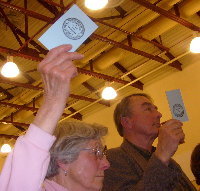 |
| Voting with a ticket. |
Some 435, or just under 10 percent of the town's registered voters decisively defeated an open-space residential development measure that would have provided breaks to developers who used cluster housing, 192-61.
The wetlands bylaw provoked far more debate and was defeated by a closer margin of 222-191. Its accompanying measure that would have instituted fines for wetlands incursions was withdrawn by the Planning Board.
Attempts at voice votes on both articles were discarded and the audience resorted to holding up blue tickets they received on registering at the meeting to show their positions. A motion to use Australian, or secret, ballot for the wetlands bylaw was defeated by voice vote.
<L2>The heads of both boards that put forward the bylaws said they would put it to their boards what to do next.
"I felt we had enough of an argument," said Conservation Commission Chairman Phillip McKnight, who pointed out the bylaw would have passed with just 16 more votes. "We'll take it up at our next meeting about what we want to do. We'll decide as a commission."
Planning Board Chairman Richard DeMayo echoed those sentiments, noting the board has two new members, Anne McCallum and Andrew Hogeland, who were elected last week. "We'll go back to the drawing board and see what direction this new board goes in."
All other questions on the 29-article warrant passed, including a $6 million general budget; $5 million elementary school budget and a $4.5 million assessment to the Mount Greylock Regional School Committee.
A request for $800,000 for the proposed Church Corners LLC affordable housing units in the former St. Raphael's Church and rectory on Cole Avenue raised concerns from neighbors but passed overwhelmingly, 346-38.<R3>
Despite the overwhelming support, Moderator Stanley Parese called for blue ticket vote for this article as well because the strong comments for and against the proposal.
Also passed was a resolution for the town to reduce its carbon footprint. The final article on the ballot, the resolution received a strong voice vote in the positive with only handful of nays from the back of the room.
<L4>The town also recognized citizens whose terms were up on various boards and committees.
Paul Langlois, who has operated the town's transfer station for 22 years, was named Employee of the Year and the Sam and Elizabeth Smith, former owners of Caretaker Farm, were presented the annual Faith R. Scarborough Award.
This article will be updated with more details in the morning.


