
Pittsfield Health Board Talks Nationwide Effort to End the COVID Emergency
PITTSFIELD, Mass. With Pittsfield still in the highest incidence rate for COVID-19 transmission, the Board of Health addressed a possible nationwide decision that the virus is no longer an emergency.
In late January, President Joseph Biden announced an intent to end national and public health emergency declarations in May. This could reportedly affect insurance coverage of tests, vaccines, and treatments.
Public Health Nurse Patricia Tremblay said that there is an expectation to hear a verdict in April and the city will continue to follow guidance from the Center for Disease Control and the Massachusetts Department of Public Health.
"There is a lot of changes, I think, that are coming," she said to the board on Wednesday.
She also reported nationwide conversations around vaccination that shift it to a regular yearly shot, similar to the flu vaccine.
"I know that the vaccine organizations, the (Food and Drug Administration) and the CDC, are all looking at the option of doing one booster a year but none of that has been voted or settled," Tremblay reported.
Berkshire County Head Start was notified by the state that they should put in their spring order for COVID test kits that are used for mitigation and were told that the free kits would no longer be provided after that time.
Board member Steve Smith asked "if and when" health facilities will no longer require masks and Tremblay said that there have already been efforts to remove that requirement in New York state.
Smith wondered what the declaration would mean for the BOH and the city.
"For a long time, we every month revisited our mask directive, which was never a mandate, but we talked about when to dismiss or get rid of the directive and when to reapply the directive," he said.
"And I just don't know, in this discussion about COVID I'm just wondering where we are."
He pointed to some peoples' view that the virus is here to stay and will have to be managed like the flu.
"I just wonder where we are with that," Smith added. "By the federal government if it's no longer an urgent type of health issue maybe it won't be back?"
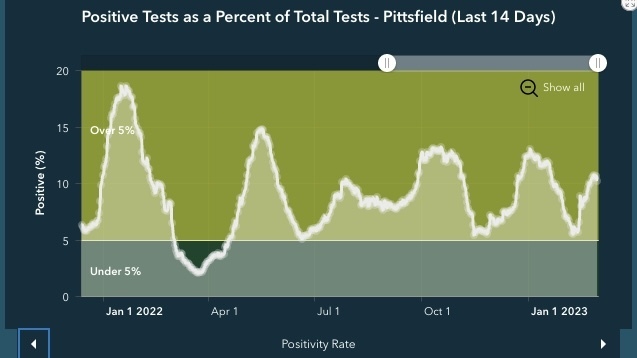
On Wednesday there were 19.7 cases per 100,000 people, 12 new cases, and 55 estimated actively contagious cases. The positivity rate was around 10 percent.
Sewage concentration has been identified as the truest way to judge the virus's impact on the community, as other metrics don't include at-home tests. There were 1.5 million copies per liter on Wednesday, compared to about 650,000 copies per liter in mid-Feburary.
There are around 7 hospitalizations for the virus at Berkshire Medical Center.
"We've had a little uptick but it was school vacation week last week and it had gotten to the point where we had relatively small numbers of cases every day, a couple of days we didn't have any cases," Tremblay explained.
"Typically the two high-risk populations we look at are children under 18 and adults 65 and over. We were getting anywhere from two to six adults in that risk population and the children were not as frequent."
The city remains in the "red zone" for transmission, having more than 10 cases per 100,000 and a positivity rate above 5 percent. It has essentially remained in this category since last year with some reprieve in the spring that put the city in the lesser "yellow zone."
Late last year, there was a death, bringing the city's count to 92.
Tremblay said it is "sort of sad" that only 77 percent of residents are fully vaccinated and 89 percent have received one dose, a metric that has been consistent for some time.
She also reported seeing two kinds of families when it comes to testing, those who test regularly and utilize the health department's free kits that are available to the public and those who are "pretty religious" about not testing for a variety of reasons.
Tags: COVID-19,
More Coronavirus Updates


