
Baker: State Support There as Schools Address Learning Loss
By Stephen DravisiBerkshires Staff
Print Story | Email Story
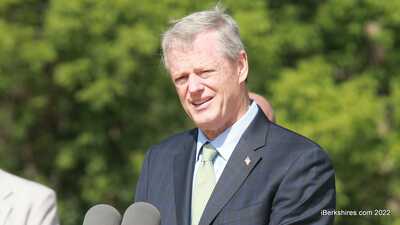
Gov. Charlie Baker speaking in Adams on Tuesday.
ADAMS, Mass. — As children throughout the county return to school this week, Gov. Charlie Baker said Tuesday that he was confident public schools have supports they need to address learning gaps coming out of the COVID-19 pandemic.
 
While face coverings, social distancing, remote learning and "hybrid" schedules largely are a thing of the past, the education deficits created by the pandemic have been front of mind for school officials for more than two years.
 
During a stop in Adams on Tuesday, Baker said he believed the commonwealth has adequately supported school districts to deal with that issue.
 
"We certainly believe the resources the state put out through the Student Opportunity Act and some of the elements that were in the budget that we signed recently should mean the locals have what I would describe as the tools and the resources to deliver on a decent year for kids," Baker said. "I think the last couple of years for kids — and adults who teach and work in the school system — have been very challenging."
 
Baker was in the Mother Town to herald the groundbreaking for the Greylock Glen Outdoor Center.
 
As the calendar turns from August to September, the two-term Republican governor has been focusing a lot on what educators hope will be the first full "normal" year of public school education since the 2018-19 academic year.
 
Last week in Boston, the Baker-Polito administration announced it would seek nearly $40 million in supplemental budget requests in the coming weeks to support safety-related infrastructure spending for schools.
 
Included on the administration's wishlist were matching grants for security and communication upgrades in K-12 schools and colleges, grant funding for an anonymous "tip line" to report potential threats, ongoing emergency response training for school officials and funding for a statewide "Say Something" public awareness campaign.
 
"These safety proposals would support a huge range of children and students, from those in child care to those at public colleges and universities," Education Secretary James Peyser said in a statement last week. "The key to these proposals is collaboration among different state agencies and different local entities. When we invest in strengthening partnerships between school districts and first responders, we help ensure that schools are safe environments focused on learning and growing."
 
Lt. Gov. Karyn Polito agreed.
 
"Children, teachers and staff deserve to feel safe in the classroom, and our administration’s funding proposal will invest in the resources and programming required to equip school communities and emergency personnel with the tools they need to keep schools safe," she said. "We look forward to working with our colleagues in the Legislature to provide critical funding for districts across the commonwealth."
 
On Tuesday, Baker pointed to past investments in programs to help keep K-12 students from falling behind during the pandemic.
 
Some of that federal money passed through the state to local school districts will continue to benefit children going forward, he said.
 
"Last year and this year, we ran pretty extensive summer school programming, which is more enrichment programming than anything else," he said. "Many hundreds of communities in Massachusetts participated in it. Some of them did their own with the federal money they have. There's still about a billion dollars in federal [Elementary and Secondary School Emergency Relief Fund] money available to school districts to spend on — whether it's after-school programs or enrichment programs or programs associated with learning loss.
 
"They can also use it for testing. There's a wide variety of things they can use that money for."

Tags: COVID-19,   schools,   


More Coronavirus Updates

Keep up to date on the latest COVID-19 news:


If you would like to contribute information on this article, contact us at info@iberkshires.com.

State, Local Leaders Celebrate Funding Boost For Ashuwillticook Rail Trail Extension

By Sabrina DammsiBerkshires Staff

ADAMS, Mass. — State officials and local leaders kicked up their kickstands and took a ride along the final stretch of the Ashuwillticook Rail Trail on Thursday to celebrate new investments in rural communities.

Federal Funds and Infrastructure Office (FFIO) Director Quentin Palfrey joined local leaders, including State Rep. John Barrett III and Berkshire Regional Planning Commission (BRPC) Executive Director Laura Brennan, in Adams to highlight the newest round of FFIO funding. The grant will provide BRPC with $64,700 in state funds to help advance the Ashuwillticook Rail Trail expansion.

"When Governor Healey came into office, one of her big day-one commitments was to make sure that Massachusetts was fighting for every dollar possible coming out of Washington," Palfrey said, speaking about FFIO, a program created in 2023 to help the state aggressively pursue and coordinate federal funding opportunities.

This builds on a $17.3 million federal award secured last year for the project, dubbed the A2A project, which supports the design of a 9.3-mile shared-use path connecting the existing Ashuwillticook Rail Trail to the Williamstown Mohican Path.

"One of the things that she emphasized to me when we set up the Federal Funds and Infrastructure Office was that we need to make sure that these resources not only come into Massachusetts, but benefit all of Massachusetts," Palfrey added.

The additional $64,700 will allow BRPC to gather information about transportation needs in northern Berkshire County to help inform the design of the trail expansion. BRPC will partner with Williams College and Luminary Evaluation, LLC to use the University of Michigan's Transportation Security Index (TSI).

Brennan said BRPC will deploy a 16-question survey that will allow them "to research local and regional perspectives and surface the needs of our neighbors when it comes to transportation in the Berkshires."

"The best-case scenario would be if the survey turned up results that all needs are met and that everyone has access to the places and the things that they need to travel to – but we know that is not true," Brennan said. "We know that folks in Berkshire struggle to get to their place of employment, to be able to access important medical appointments, [and] other engagements. So, the transportation security index is going to help us really hone in on those specific needs, identify pockets of needs or areas where there is a strong concentration or depth of need."

She said FFIO's investment offers a "wonderful augmentation" to BRPC's current plans for the bike trail extension. It's also an investment that will make the region more competitive for other transportation opportunities.

"This is an incredibly multifaceted and valuable investment, and we deeply appreciate it," she said.

Barrett said these investments drive growth in the Berkshires.

"I've always found that if you're going to grow an area, you grow with what you have here to grow. You don't bring something in. We have a natural beauty. We have an environment that's second to none, and that's what we are going to grow on," he said.

Barrett said that in the First Berkshire District alone, 4,000 new people moved to the area.

"We're seeing that migration here. They're going to have activities. They're going to have jobs, and we're going to have a great educational system that goes with it with our two colleges that are here," he said.

Palfrey said it was clear during the initial creation of FFIO that federal funding often went to wealthier and more urban communities with larger planning departments and greater access to consultants. He added that FFIO helps reverse this trend and get projects in rural communities off the ground.

View Full Story

More Adams Stories