
Anthony Museum Opening Sparks Debate on Abortion
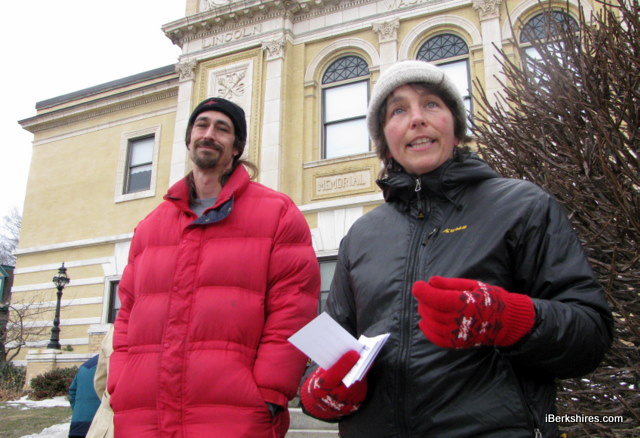 Ben and Jeanne Matthews stand outside the Adams Free Library on Sunday to pass out leaflets directing people to a Web site on the new Anthony Museum's links to anti-abortion groups. |
ADAMS, Mass. — Plans for the Susan B. Anthony museum at the suffragist's birthplace on East Road sparked controversy almost as soon as Carol Crossed purchased the property at auction in 2006.
A peace activist, Crossed has long been involved with groups advocating against abortion, including Feminists for Life of New York, which she intended to use the property in some way.
It was rumored for awhile that the house would be moved to Rochester, N.Y., where the group was headquartered, that it would be turned into a home for pregnant teens or headquarters for an anti-abortion chapter. So there was a sigh of relief in town when Crossed announced in early 2008 plans for an Anthony museum.
But some historians and abortion-rights activists say that group and others have been liberally interpreting Anthony's beliefs on abortion and that the museum won't express history but anti-abortion ideology. Anti-abortion groups insist the evidence is there if historians just opened their eyes.
Anthony is an iconic figure in the fight for women's rights and both sides have been been tussling over her stance on the issue — if she had one, that is.
On Sunday, Crossed made it clear where she thought Anthony stood during her remarks at the activist's 190th birthday celebration, shortly after opening the museum.
"Some of you know there's been some controversy around the museum," said Crossed. "As in her life, even in her death, Susan causes controversy, doesn't she? She would really enjoy that."
While it was good news she brought people together to make the museum happen, the "bad news," as she described it, "is through historical facts, the truth was going to be told in the museum, whether it was politically correct or not."
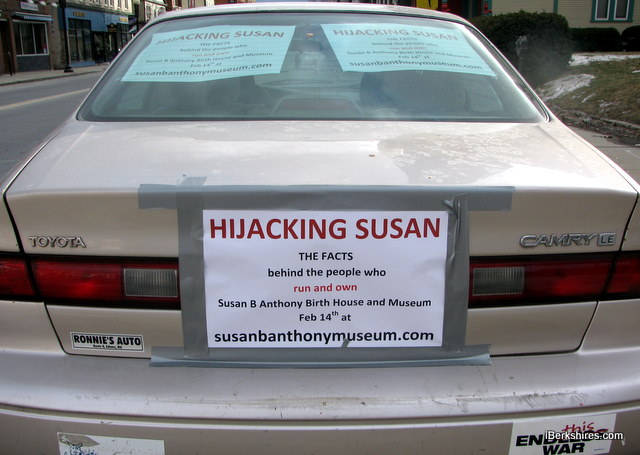
Crossed's statement got a round of applause in the Memorial Hall in the Adams Free Library, but not outside where a handful of people stood at the library steps handing out leaflets warning that Susan B. was being hijacked.
Jeanne Matthews said it wasn't a protest but some friendly, informal "leafletting" to let residents know what was happening at the museum at susanbanthonymuseum.com.
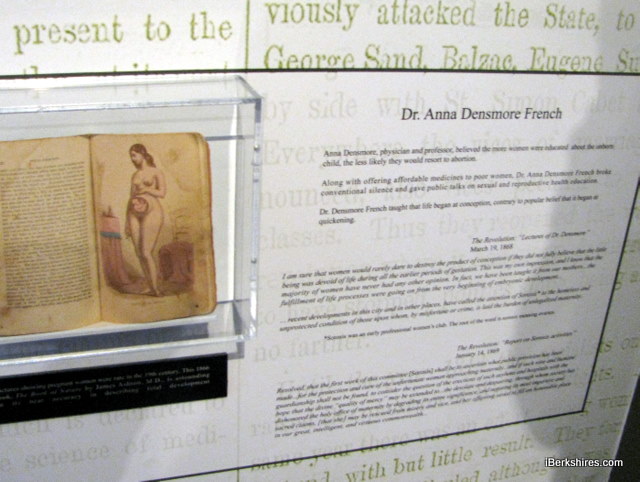 Dr. Anna Densmore French appeared in The Revolution. She believed that women who were educated about their pregnancies would be less likely to abort them. |
"We want people to know there's more context for discussion about Susan B. Anthony's views," said Matthews, who says the museum's directors are using the town's heroine as cover to put forth their own agenda against women's reproductive rights.
Her husband, Ben, agreed, "we just want more people to know that in supporting the museum they support Feminists for Life."
The New York chapter has changed its name to Feminists Choosing Life of New York, and is heavily involved in the museum board's make-up. A late 2007 newsletter by organization state's the two entities will be separate but FCLNY "retains control of the selection of SBABM Board members and of the development and direction of the museum itself."
In addition to Crossed, as president, the board includes textile historian Kelly Vincent-Brunacini, who is also president of Feminists Choosing Life. The mission statement of the museum describes Anthony as "a noteworthy figure in the abolitionist, pro-life and temperance movements of the 19th century."
A historian was hired as the full-time director last year after spending some months before working with the museum. She left abruptly in December and Sally Winn, a former vice president of Feminists for Life, was hired to replace her.
So what is in the Susan B. Anthony Museum? Well, there aren't any of the disputed quotes or articles that have heated up the debate.
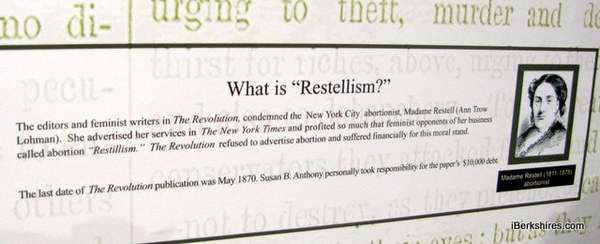
Instead, among the exhibits on abolition, suffrage and temperance in the "Legacy Room" is a section that focuses on "Restellism," a term popularly used in the 19th century for the results of Madame Restell, a New York City abortionist and birth-control peddler.
Anthony's contemporaries who abhorred the practice and published in her paper, The Revolution, fill the space. The fact that The Revolution rejected advertisements for abortifacents is stated and a quote from her diary in reference to a sister-in-law's difficult abortion (as cited in the Stanton and Anthony papers' project at Rutgers) is offered.
The implication is clear but, like Anthony, never specifically states her position.
 It's not about placing her on one side or the other of a contemporary debate, said Winn. "To reduce her down to a soundbite is doing a great disservice to women."
"She was all about resources for women," she continued, something that FCLNY is all about. "If she were here today, I think she'd be proud of those resources."
Crossed said Anthony was full of contradictions — a Quaker who wore jewelry, a lover of peace who backed John Brown militancy. "The truth was sometimes complicated, almost always unpopular."
Matthews said the museum and its board have the right to exhibit want they want — but people should know its agenda.
"It doesn't have to be an argument; it can be a conversation," she said.


