
A Dance to Jules Feiffer
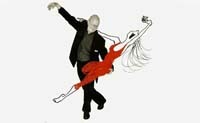 |
| Free to the public through August 30. (Photo Courtesy of Jacob's Pillow) |
BECKET, Mass. - A Dance to Jules Feiffer, the exclusive exhibit of works by Pulitzer Prize-winning cartoonist Jules Feiffer, enters its final two weeks on display at Jacob’s Pillow Dance Festival. Free to the public through August 30, this exhibit relates the art of movement and expression as seen through Feiffer’s eyes. It brings together an expansive array of original works, interspersing cartoon strips with watercolors, and political commentary with dance imagery.
Most of the 46 featured works are originals, and the collection also includes signed, limited-edition prints. All works may be purchased, with a generous portion of the sales price designated for the benefit of Jacob's Pillow, a non-profit organization. One of Feiffer’s most recent works, a single-panel paean to the new President entitled “Obama! Ourbama!,” is close to selling out, with only a handful of signed prints available at $200 each. Marking the first time Jules Feiffer’s portrayal of movement—prominent throughout his career in alternately satiric and affectionate moods—has been singled out for an in-depth survey, this exhibit confirms Feiffer’s telling remark that “gesture is what my work is about.”
The exhibit was recently celebrated by Deborah Jowitt, dance critic for The Village Voice, who wrote, “Longtime Voice readers have never forgotten the weekly joys provided for many years by Jules Feiffer's cartoons. On view in Blake's Barn, there's a fine selection of his characters: the glum couples; the baffled, politically conscious folks; and the eternally optimistic, eventually wilting modern dancers…A dance to summer, if ever there was one.”
A Dance to Jules Feiffer coincides with both Feiffer’s 80th birthday year and the publication of Explainers, the first volume of his collected strips. As Roberta Smith writes in The New York Times, “Mr. Feiffer’s genius for line encompasses the skills of the psychologist, linguist, fashion illustrator, social critic, political commentator, choreographer, and dramaturge."
“We specialize in “firsts” at the Pillow, and this exhibit is one I’m especially proud of,” comments Ella Baff, Jacob’s Pillow Executive Director. “This is the first time that many of Mr. Feiffer’s movement and dance works have been seen publicly. The exhibit also reveals the depth and variety of his creative output; he is a great artist, a great mind, and lucky for us, he has definitely released his inner dancer.”
Feiffer’s interest in dance and focus on gesture as the means of expression make him an idiosyncratic and fitting partner for America’s longest-running dance festival. This exhibit was conceived and curated by Norton Owen, the Pillow's Director of Preservation, who collaborated with Feiffer in selecting the works on display. The resulting exhibition has taken shape in Blake’s Barn, also the home for the Pillow’s extensive dance archives, encompassing 46 framed works on the walls, more in a display case, and still more viewable on video monitors. A Dance to Jules Feiffer offers the chance to enjoy Feiffer’s “full-bodied, well-rounded yet exquisitely Minimalist talent” (Roberta Smith) in a variety of mediums—pen and ink, charcoal, marker, and watercolor. Two recurring figures of the exhibit are Feiffer’s cartoon interpretive dancer, famous for her “Dances to Spring,” and Fred Astaire, whose debonair example casts a far-reaching influence over the cartoonist’s life.
On July 26, Feiffer and his daughter Kate Feiffer participated in Jacob’s Pillow’s annual Community Day, reading from Which Puppy?, their recently-published children’s book about the First Family’s search for a pet. Feiffer returned on August 5 to sign copies of Explainers and give a PillowTalk—one of the festival’s moderated discussions. At the talk, he expressly thanked Jacob’s Pillow and Norton Owen, commenting that Owen had expertly “choreographed” the exhibition.
Best-known as a fixture of The Village Voice for 44 years, Jules Feiffer has also earned recognition as a playwright (Little Murders), screenwriter (Carnal Knowledge), and as a writer and illustrator of children’s books (Bark, George, and The Man in the Ceiling). He was born in the Bronx in 1929 and never studied dance, though a lifelong fascination with Fred Astaire began in childhood. After an apprenticeship to graphic novel pioneer Will Eisner in the 1940s, Feiffer began publishing his own strip, “Feiffer,” in The Village Voice in 1956. His interpretive dancer made her first of many appearances a year later. Feiffer won an Oscar in 1961 for his animated short, “Munro,” and his editorial cartoons for the Voice were awarded the Pulitzer Prize in 1986. Until its end in 2000, “Feiffer” was a Sunday syndicated feature in The Boston Globe, The Los Angeles Times, The Miami Herald, The Chicago Sun-Times, and London’s The Observer. Eulogizing the strip, Mr. Feiffer declared “the dancer is retired.” Since the beginning of this decade, Jules Feiffer has focused on writing children’s books, painting watercolors of dancers, and other creative pursuits such as the 2003 Lincoln Center Theater production, A Bad Friend.
For more information on Jules Feiffer and the exhibit, please visit www.jacobspillow.org and www.julesfeiffer.com. For purchases and inquiries, contact Norton Owen, Director of Preservation, at nowen@jacobspillow.org or 413-243-9919, ext. 50.


