
Clark Fellow Kavita Singh Speaks On Maharaja Museums

Print Story | Email Story
WILLIAMSTOWN, Mass. - In a lecture titled "At Home With My Maharaja: Entering the Palace-Museum in India," Sterling and Francine Clark Art Institute Fellow Kavita Singh examines the palaces of Indian maharajas that have been turned into public museums. In particular, she discusses the Mehrangarh Fort Museum at Jodhpur in Rajasthan and Mysore Palace in Karnataka, southern India. The lecture, held on Sunday, July 26, at 3 pm, is free.

Although India is often thought of as a former British colony, about 40 percent of the subcontinent was never under direct British rule. Instead, these areas were ruled by Indian princes called maharajas, who exercised a restricted freedom under British supervision. Today, India's map is dotted with the maharajas' former palaces, many of which have been converted into museums. The opening of these palaces created a new kind of public space that plays a complex role in contemporary India. Singh discusses this role before focusing on the current life of two magnificent palace-museums.

Singh is an associate professor at the School of Arts and Aesthetics, Jawaharlal Nehru University, New Delhi, where she teaches courses on museum and curatorial studies and the history of Indian painting. She has published on Indian courtly and folk painting, as well as South Asian museums. Her curatorial projects include Power and Desire, an exhibition of Indian courtly painting for the San Diego Museum of Art, and Where in the World, the current exhibition at the Devi Art Foundation, India's first contemporary art museum. She is working on a book on the history of museums in India, and her research focuses on the place of museums in India's current social landscape. Singh holds a holds a PhD in art history from Panjab University, Chandigarh, India; an MFA in art history from Maharaja Sayajirao University, Baroda; and a BA in English literature from Delhi University.

The Clark offers between fifteen and twenty Clark Fellowships each year. Fellowships are awarded to national and international scholars, critics, and museum professionals whose work extends and enhances the understanding of the visual arts and their role in culture. The program encourages a critical commitment to research in the theory, history, and interpretation of works from all periods and genres.

A dynamic center for research and higher education in art history and criticism, the Clark hosts an international fellowship program; regular conferences, symposia, and colloquia; and an important art research library. The Clark, together with Williams College, jointly sponsors one of the nation's leading M.A. programs in art history, which has been part of the professional development of a significant number of art museum directors, curators, and scholars.

The Clark is located at 225 South Street in Williamstown. The galleries are open Tuesday through Sunday from 10 am to 5 pm (daily in July and August). Admission is free November 1 through May 31. Admission June 1 through October 31 is $12.50 for adults, free for children 18 and younger, members, and students with valid ID. For more information, call 413-458-2303 or visit clarkart.edu.
If you would like to contribute information on this article, contact us at info@iberkshires.com.

Prospect Meadow Farm Opens New Vocational Barn

By Breanna SteeleiBerkshires Staff

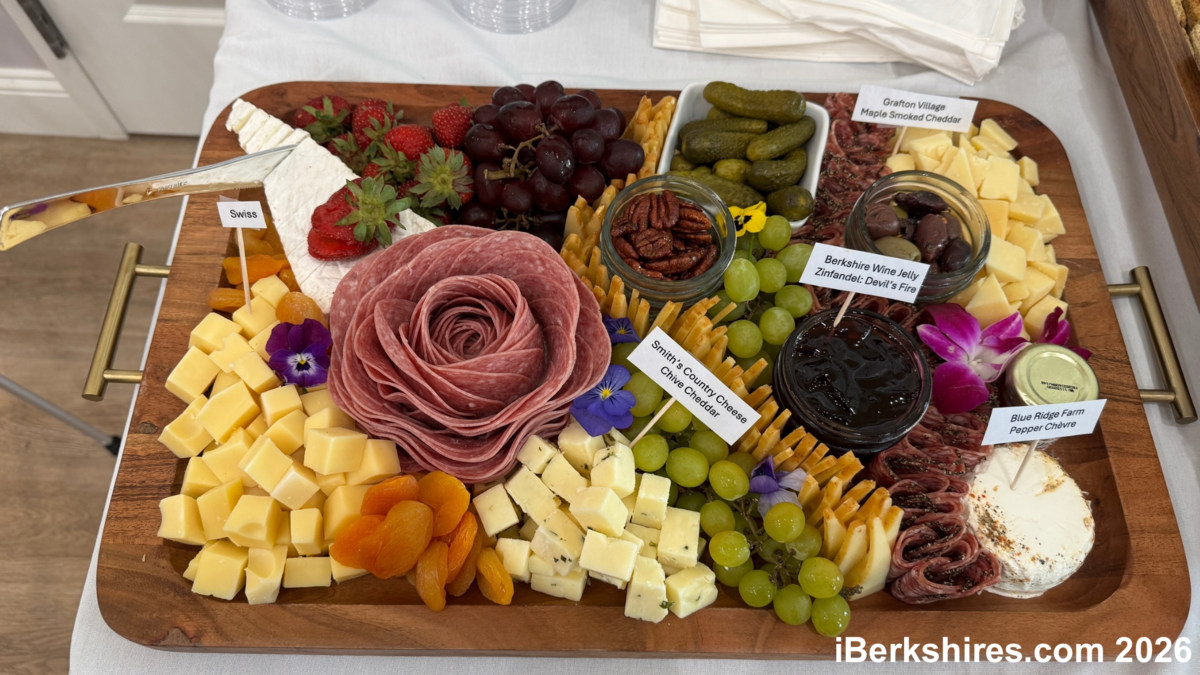
A charcuterie board at the event displays fare from some of the regional producers.

PITTSFIELD, Mass. — Prospect Meadow Farm last week officially opened a new barn to sell plants and other goods it produces.

Prospect Meadow Farm Berkshires is an expansion of ServiceNet's first farm in Hatfield that has provided meaningful agricultural work, fair wages, and personal and professional growth to hundreds of individuals with intellectual and developmental disabilities since opening in 2011. 

The Berkshires farm opened on Crane Avenue two years ago and has now introduced a new vocational and unwinding space for the more than 25 farmhands who get paid a minimum wage.

"This is a facility for our folks who work on the farm to learn additional skills and do additional work," said Vice President of Vocational Services Shawn Robinson at the Friday event. "So we have a food packaging space, we've got a walk-in cooler space, we've got a floral design space, we've got a farm store room for staff, lunch room, and then a meditation room that we're standing in now, which is when you're having those hard moments and you need to get away from everything.

"This is going to be a peaceful place you can find and sort of find some comfort, and then hopefully get back to work."

The barn was built by funds from the state Executive Office of Economic Development and the state Department of Agricultural Resources that equated to around $600,000, with ServiceNet contributing around the same amount. The structure took over a year to build.

The state's Department of Developmental Services Commissioner Sarah Peterson spoke on how meaningful this farm and ServiceNet is to her and that this place is important to those who need it.

"Places like this are so crucial because they create opportunities for people living with disabilities that aren't plentiful," she said. "People living with developmental and intellectual disabilities have an unemployment rate over 25 percent five times the rate for people without disabilities, even more jarring is under appointment, which is at 80 percent. That means that four out of every five people with disabilities earn below market rate wages and have limited upward mobility.

"The building itself is really impressive, but what you're really seeing here is the result of vision. It's about opportunity, it's about community, and it's founded in the belief that every person deserves the chance to learn and work and contribute to thrive under the leadership of ServiceNet."

One aspect of the barn will be the market where produce from the farm and other local growers will be sold as well as keeping the tradition of Jodi's Seasonal, which previously occupied the location, alive with plant sales. The market will be open Monday through Saturday from 10 a.m. to 3 p.m.

"Everything you see in terms of the tomatoes, the fresh produce, that's all done with the hands of our farm hands here, individuals with disabilities who get out every single morning, get in those greenhouses, put their hands in the dirt, and make all of this happen, and this is just the start," said Robinson. "This farm is a little over a year old at this point, but give it another two years, and we hope to be growing enough food to share throughout the Berkshires."

Robinson said the farm is focused on local food security, recently partnering with the Hatfield Council on Aging and planning to work toward making enough food to partner with places in the Berkshires.

He said the barn serves the Hatfield farm and what the employees here needed.

"We've been able to learn the needs of the farm hands who work there and so we have learned that they need a comfortable break space for those times where it's hard to be out in the fields, we've learned that a quiet space for when you're going through something you need to be away from people are key, and then also we have a small farm store in Hatfield, but we've seen increasing interest in retail work from our participants, so we thought it was time for a larger-scale farm store," he said.

Robinson noted that Prospect Meadow Farm has helped the individuals working there feel valued and head.

View Full Story

More North County Stories