Groupe Emile Dubois - U.S. Premiere at Jacob's Pillow
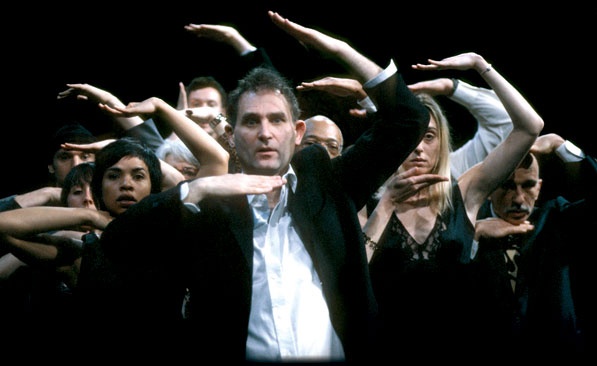 BECKET, Mass. – Jean-Claude Gallotta’s critically acclaimed French dance-theatre company, Groupe Emile Dubois returns for its first American engagement in 20 years July 15–19 at Jacob’s Pillow. The company will perform the U.S. premiere of Des gens qui dansent, a whimsical work choreographed by Gallotta that weaves spoken narratives amidst movement that is both technically exquisite and pedestrian.
 Performed by ten dancers of varying ages, shapes, and sizes, Des gens qui dansent challenges traditional ideas about the dancing body as it tells the stories of ordinary people -- two lovers, a mother and daughter, an elderly man --crossing paths in a variety of situations. In this charming, evocative production featuring Gallotta’s idiosyncratic choreography, the dancers bring everyday life to the stage, showing clearly and honestly the relationships individuals foster with one another.
Ella Baff, Jacob’s Pillow Executive Director, comments, “This is a wonderfully inventive production that is touching, funny, poignant, off-beat, and I think very universal. Its title, which translates in English to ‘people who dance,’ is an apt description. We are invited into the lives of all kinds of people on stage, whose encounters with themselves, others, and the world at large make powerful connections with the rest of us.”
Groupe Emile Dubois is the resident company of the Centre Choréographique National de Grenoble. Founded in 1979 by Gallotta and Mathilde Altaraz, the company is an experimental dance-theatre troupe that brings actors, musicians, dancers, and visual artists together in works that emphasize the relationship between performer and viewer. Des gens qui dansent, choreographed by Gallotta in 2006, is the third installment in a trilogy of dances showcasing non-traditional performers of a variety of backgrounds, ages, and dance training. The first, 99 duos, was choreographed in 2002, followed by 2004’s Trois Générations.
In Des gens qui dansent, the dancers are costumed in normal clothes—business suits for the men, casual dresses for the women—and appear no different from the audience, save for the fact that they are on stage, jumping, leaping, and twisting their bodies in free spirited movement. As the dancers navigate through relationships and shared experiences in duos, trios, and as a group, they come to represent reality without artifice. With music by French electronic composer Strigall and dramatic staging by Claude-Henri Buffard, Des gens qui dansent displays the importance of human contact with tender urgency. France’s La Croix proclaims that “…moving, joyful and poetic, this latest opus talks, quite simply, of life.”
On Saturday, July 18 at 4pm, Gallotta will participate in a PillowTalk titled People Who Dance in Blake’s Barn. Joined by other choreographers and directors who work with non-traditional dancers, Gallotta will discuss the universal role that dance plays in our everyday lives.
Groupe Emile Dubois first performed in the United States at the 1984 Olympic Games in Los Angeles and made its New York City debut in 1985 to enthused fanfare, garnering a profile in The New York Times. But it wasn’t until 1987 that they became an international success, with the North American premiere of Gallotta’s ballet Mammame at the Montreal International Festival of New Dance. As Anna Kisselgoff of The New York Times reported in an article after the event, “By Wednesday, Mr. Gallotta was hailed as a genius in several quarters, and the moderator interviewing him at a public panel asserted that Mammame was unlike anything seen previously in Montreal.” She went on to write, “What Mr. Gallotta himself is good at is reinventing the wheel, hence the absolute aura of freshness that pervades his work. Within the auto-didacticism that pervades France's experimental climate, he has certainly created his own theatrical world.”
A native of Grenoble, Jean-Claude Gallotta studied fine arts before deciding to interrupt his schooling to experiment with edgy performance works that combined theatre, dance, music, and art. In 1978, Gallotta traveled to New York, where he was introduced to the choreography of legendary modern dance iconoclast Merce Cunningham. After returning to Grenoble in 1979, he founded Groupe Emile Dubois and in 1981, the troupe moved into Grenoble’s Maison de la Culture, where they are still housed today. Gallotta was appointed director of the Maison de la Culture in 1986, becoming the first choreographer to lead such an institution, and remained in that post until 1990, when he stepped down to focus on his first book, Mémoire d’un Dictaphone, published that same year. Though it has been 22 years since Groupe Emile Dubois last performed in the U.S., Gallotta and his company have remained in high demand.
The company has toured annually to festivals all over the world and performed in 23 countries, including Australia, Japan, Brazil, Mexico, and much of Europe. Gallotta’s work has been commissioned by the Lyon Opera Ballet, and he spent three years as the director of a newly-formed dance department at the Shizuoka Performing Arts Centre in Japan, where he founded and directed a resident company of eight Japanese dancers. He most recently created Bach Danse Expérience and Chroniques Chorégraphiques – Saison 1 for his company, both of which premiered in 2008.
A social media initiative inspired by Des gens qui dansent, Jacob’s Pillow launched “Why Do YOU Dance?” an online video inquiry which poses this question of everyday people. Responses from around the country and the world are posted on the Jacob’s Pillow website at www.jacobspillow.org.
For more information about Groupe Emile Dubois or Jacob’s Pillow, visit www.gallotta-danse.com/jcg_en.asp or www.jacobspillow.org.