
HooRWA Volunteers Clean Up Adams
 Photos by Kathy Keeser
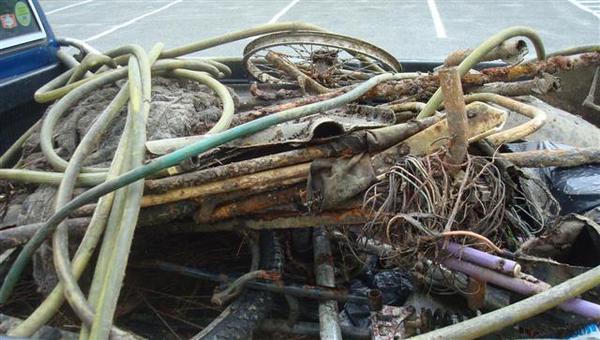
HooRWA President James Niedbalski drags from the river during the Adams cleanup. |
For the volunteers who spent five hours on a recent Saturday dragging out of the Hoosic River and from various sites around the town, the answer was a resounding "Yes."
"It's disgusting — bagged animal body parts, toilets! We found full toilets dumped, one near the Susan B. Anthony home and one on Mount Greylock, when we were accessing locations for the Adams cleanup," said Hoosic River Watershed Association volunteer Joanne Hurlbut. "We found spots that seem to have become dumping locations that local people must use. It is amazing the amount of trash you can find, that people would just throw out stuff in public locations off the road or on rivers that should be disposed of properly."
The "Adams Cleans Up (the Hoosic)" event took place on Saturday, May 16, at eight locations: the Hoosic River and banks at Lime Street; the Adams Industrial Park from Print Works Drive down to the Cook Street bridge; the bank of Bassett Brook below Bassett Brook Reservoir, off Mason Road; Bellevue Falls; Fisk Street near West Road by Peck's Brook; Gould Road at the Greylock Glen near Peck's Falls; near the Discover the Berkshires Visitors' Center on Hoosac Street; upper East Hoosac Street above Oak Tur, and Route 8 across from Mullen Mayflower.
"I was pleased by how hard the participants worked and by how much trash we were able to collect, but I was also a little overwhelmed by the kinds of things we found," said Caroline Scully, a cleanup organizer and South Branch Team coordinator for HooRWHA.
Scully said there were years-worth of used cat litter, double-bagged and thrown over the bank above Bassett Brook that were very heavy and difficult to bring up the bank; dirty diapers; several bicycles; a lawn mower; a vacuum cleaner; a computer printer and monitor; an easy chair; bathroom tiles; pallets; used hyperdermic needles; many cans and bottles of all sizes; a garden hose; and "even a Farm Aid concert CD."
The cleanup was sponsored by HooRWHA and supported by a grant from the William J. and Margery S. Barrett Fund of the Berkshire Taconic Community Foundation. Participants met at the visitors center and went out to locations as teams armed with trash bags donated by American Rivers and gloves donated by Greenberg's and Stanley's Lumber & Building Supplies.
James Niedbalski, president of HooRWAH's board, loaned his time and truck to do final pick up of bagged trash and large items. All the rubbish was put into a large roll-off container donated for the event by Delmolino & Sons.
 HooRWA member Lauren Stevens and son Tommy bag up trash. |
Trash dumping and litter are not just a problem in Adams. The next time you are sitting at a stop light, or walking, take a look around. You'll be surprised how many empty cups, fast-food trash, cigarette butts, and other items that you can see.
Why do people litter and dump trash? Keep America Beautiful says it may be because people don't feel a sense of ownership over the land they're littering, or believe it's someone else's job (public works or parks) to clean up debris. It also costs more and more to get rid of rubbish and the money factor may be leading people to toss their trash by roadsides and rivers.
In Adams, trash is no longer accepted at the town landfill; instead, residents must hire trash haulers to take their junk away and pay various fees for different types of debris through the Northern Berkshire Solid Waste Management District.
Trash can take a long time to decompose — a million years for Styrofoam or a plastic jug; 3,000 for a glass jar; 220 to 500 for an aluminum can; 550 for a disposable diaper; 90 for a tin can; 45 for a leather shoe, and a year for a wool sock.
The waste-management district oversees collections and sites for Adams, Cheshire, Florida, Hancock, Hinsdale, Lanesborough, New Ashford, Peru, Savoy, Williamstown and Windsor. Special collections for household hazardous waste and bulky waste (like couches, mattresses, appliances, carpet and the proverbial kitchen sink). Fees range from $2 to $35, based on size and residents can purchase
 The district offers special collections at varied times during the year but tires can be dropped off at the transfer station on East Road.
Berkshire County also has a resource for recycling: the Berkshire County Freecycle Network that helps to reduce waste by matching people who have stuff with people who need stuff.
Why worry about litter? Because it costs in the end in degradation of the environment, encouragement of more littering, and in taxpayer dollars.
"Massachusetts taxpayers spend millions of dollars annually on litter pickup," according to state Highway Commissioner Luisa Paiewonsky.


