image description

That's Life: O, Christmas Tree
By Phyllis McGuireiBerkshires Columnist
Print Story | Email Story
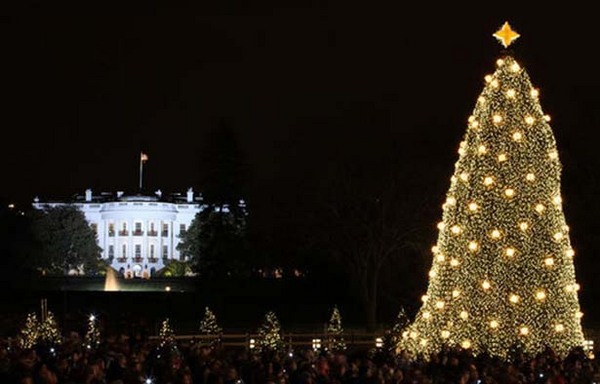
The ceremonial lighting of the national Christmas tree in Washington, D.C., and the Rockefeller Center tree in New York City were televised, and many of us watched the events this year as we sat on the sofa, cozy at home.

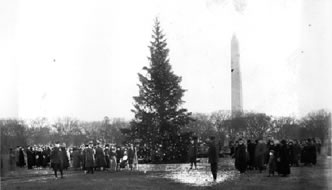
Television was in its infancy when a national Christmas tree was erected on the White House ellipse for the first time during Calvin Coolidge's presidency (1923-1929). With a flick of a switch, President Coolidge set aglow the 2,300 lights on the 48-foot tree, a gift from his home state of Vermont.

The national Christmas tree remained dark following the assassination of President Kennedy, and during the hostage crisis in Iran.

Here in the Berkshires, townsfolk brave cold weather to be present when pine trees growing in town squares (or trucked in from nearby yards) are illuminated in celebration of the holiday season.

And in homes across America, fresh fir trees are set up and bedecked with ornaments, candy canes and strings of lights. Some people, however, prefer manufactured Christmas trees as they do not shed needles and can be stored from year to year.
 

National Park Service 
President Coolidge lights the first National Christmas Tree, from his native  Vermont, in 1923.

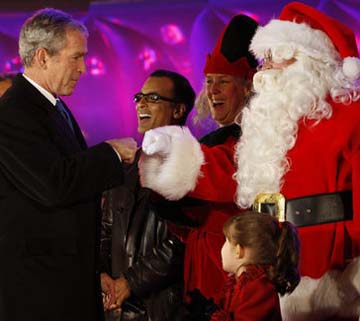
President Bush lights up
Artificial trees, made of feathers, were introduced in Germany in 1850 and after, World War I, trees that closely resembled live evergreens became available at a price of $9. Now, artificial trees that rotate on a stand and have "snow-tipped" branches and permanent lights sell for as much as $400. Those of Donald Trump's ilk might consider buying a white spruce that luxury department store Neiman-Marcus offers for more than $4,000.

The Christmas tree tradition, according to one legend, took root the night the baby who would be called Jesus was born. All the flora and fauna brought gifts to the newborn, trees putting their fruit at His feet. But a little fir tree did not approach the baby as he was ashamed because he had nothing to give. Feeling sorry for the little fir tree, an angel sent a cluster of stars to rest on its branches. Jesus smiled when he saw the little tree and commanded that all fir trees be illuminated to please children.


Another story tells of Martin Luther, a German priest and philosopher, illuminating a Christmas tree for the first time in 1550. A resident of Strasbough, Germany, noted in a journal that people who brought evergreen trees into their homes to commemorate the birth of the Christ child decorated them with paper roses, apples, wafers and gold foil.
 
In the 19th century, young ladies handcrafted snowflakes and angels to hang on Christmas trees, and those with a talent for creating scrumptious sweets contributed candies and cookies. Since children liked to sample those sweets, a tree would look different from day to day.
 
It is believed that the Christmas tree tradition traveled to the United States during the American Revolution, brought by Hessian soldiers. And by the beginning of the 20th century, Christmas trees were set up in 80 percent of American homes.

Of the 35 million to 60 million evergreen trees sold in the United States, the most popular species are Scotch pine, Douglas fir, white pine and sable fir.

Some families like to tag a Christmas tree long before they address holiday cards, and then return later in the season to chop down the tree and cart it home.
 
Recently, at a shopping center, I noticed there were two trees tied to the roof of a vehicle, and I wondered if they would be displayed in the same home, one on the porch and one in the living room. A friend of mine who lives in Springfield does that, and I admire her energy.
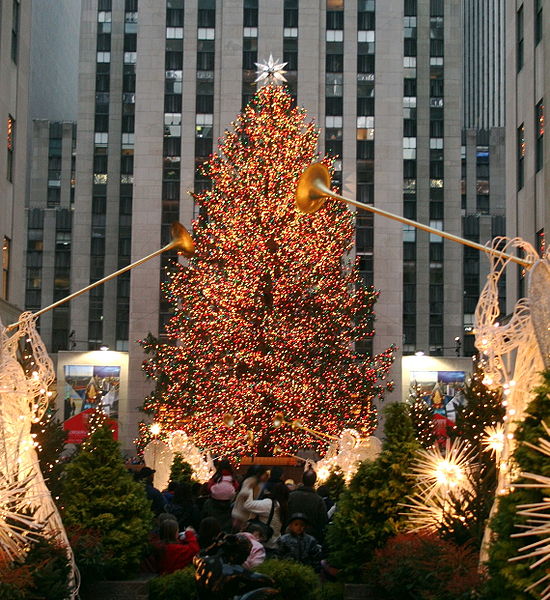
Rockefeller Center's 2006 Christmas tree
The Rockefeller Center Christmas tree tradition evolved from a humble beginning in the Great Depression when workers constructing the massive complex set up a small balsam fir and decorated it with fruits, garland and tin cans. It is likely that none of those workers are living today, but one wonders what they would have thought of the towering tree that graces Rockefeller Center today. As a former New Yorker who still visits Rockefeller Center most Christmases, I know that when I view the tree and the other sights on a festive Fifth Avenue, my spirits soar.

How wonderful it would be if the Christmas spirit dwelled within us throughout the year! Then we would always greet everyone we happen to meet with a cheery "Hello," look  in on our elderly neighbors, contribute to charities that help those in need, and instead of giving into fear of the future, we would count our blessings.
If you would like to contribute information on this article, contact us at info@iberkshires.com.

Lanesborough Town Meeting to Vote Budget, Bylaws & Vehicle Purchases

By Breanna SteeleiBerkshires Staff

LANESBOROUGH, Mass. — Tuesday's annual town meeting includes a $14 million operating budget, new short-term rentals, accessory dwelling units and sign bylaws, and free cash article appropriations.

Voters will gather at Lanesborough Elementary School on June 9 at 6 p.m. to decide on 20 warrant articles.

The fiscal 2027 budget is up a little over 10 percent. Some of the main increases are the Mount Greylock Regional School District and McCann Technical School: the McCann assessment is up more than 30 percent based on factors including enrollment and the school renovation project, and Mount Greylock's is up 11 percent.

Article 11 is for the town to vote to approve from free cash the sum of $16,298.48 for the McCann Technical School roof and window replacement project so as not to impact the budget. Article 3 is  appropriate $7,586,284 for Mount Greylock Regional School assessment.

Another notable increase was in life and health insurance, showing an increase of about 26 percent.

Ambulance Director Jen Weber is planning 24-hour coverage, which means more staff and a hike in her budget. One of the articles asks the town to appropriate $234,100 to operate the Ambulance Enterprise Fund for salaries and expenses.

Many town departments are looking for new vehicles. The Fire Department is looking to replace its outdated 1996 fire engine. There are two articles related to the truck at a total of $813,366. Article 12 would transfer $225,000 from free cash into the Fire Truck Stabilization Fund; Article 13 would transfer $605,000 from the fund and authorize the borrowing of $208,366.08.

The total includes a $100,000 contingency cost to cover any additional costs if a 2026 model-year chassis cannot be secured before new emissions standards go into effect in 2027.

The board at its last meeting moved the $225,000 transfer to come before the borrowing article, changing the stabilization number. If the $225,000 is not voted on, then they will amend the next article's number on the floor, subtracting the $225,000. This shows the borrowing number significantly lower.

Article 17 asks for the transfer of $80,000 from free cash to replace a police cruiser.

Police Chief Rob Derksen's aim is to replace one vehicle every other year, meaning the oldest vehicle gets replaced about every 10 years. 

He stressed that if delayed this year, the town may have to double up in a future year to get back on schedule, and that paying later usually costs more. The article will ask for $80,000 from free cash, the vehicles used to be funded by the BHRD.

Lastly, the Highway Department is looking to replace a 2014 International dump truck that will be a total of $330,000 and will take two to three years to receive.

Money will be used from last year's approval of $250,000 from free cash for the replacement of a 2012 highway front-end loader that was underspent $49,261. Town meeting is being asked to approve  a transfer of $53,274.85 from free cash and the use of $227,464 from funds from the Sale of Town Real Estate to fund the balance.

Other free cash proposals include $1,200 to purchase software to support tracking and ongoing maintenance schedules of town-owned vehicles; $42,000 for the replacement of the Highway Department's storage shed roof, $200,000 to reduce the tax levy.

View Full Story

More Stories