
Kids Get Experiment Experience at Williams Science Camp
 |
| Photos by Susan Bush/Williams College |
"Kids at this age are naturally scientific," said chemistry professor David Richardson. "I've never met a kid who isn't an experimenter. They bring such great energy to our labs and their energy is contagious."
Funded by a Williams College endowment from the estates of George Olmsted, Jr. '24 and his wife, Frances, the summer science camp was founded nearly 10 years ago by chemistry professor Charles M. "Chip" Lovett and Richardson. The program is open to students entering the fifth and sixth grades. This year, 20 students attended June 30-July 3 session, and 27 students enrolled for the July 7-11 session.
Key camp components are youthful exuberance and genuine curiosity about the how and why of the science world.
"The kids are so excited about science and that is really rewarding," said Lovett. "It's great to see them involved and thinking about the experiments."
Williamstown Elementary School teacher Madeline Levy is the program's director. "The camp provides enormous student opportunities," she said. Science and technology are so important in our world. At Williams, our campers learn in a state-of-the-art facility and from two senior professors, who make this so kid-friendly and yet keep a high level of sophistication about the experiments."
This year, the camp theme focused on chemical and molecular changes.
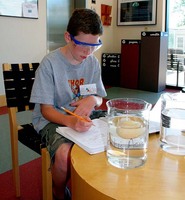
 "Students watch for changes and record these in their journals," said Levy. "We put an egg in water and an egg in vinegar; students look each day for the changes: what's happening? There are balloons filled with different gasses; what's happening? We have a carrot in salt water and a carrot in plain water; what's happening with the molecules?"
It's the hands-on component that generates student enthusiasm, said Williamstown Elementary School fifth-grade student Charlotte Rand. "I like all the experiments and I really like being able to do things myself and not just watch."
A typical day begins with documenting observations about each "mystery." Students then move to a laboratory, where Lovett and Richardson launch into animated discussions about science. The students respond eagerly, with many hands raised and waving to answer the questions posed by the faculty.
Zach Armet attends Pine Cobble School. "The camp is fun and I'm learning a lot," he said. "I think this is an awesome camp. I love the mysteries and I think they are so much fun to think about."
Local teachers work with groups of three to five students. Williamstown teachers Juliann Haskins, Kathy Morris and Bonnie Dingman, and Hawlemont Regional School (Charlemont) teacher Stephen Bechtel are among the camp's instruction contingent. They said making the Science Center at Williams available to kids is a wonderful gift and the hands-on science experience makes the camp dynamic.
"There's structure, but at the same time, the kids can come up with their own ideas and take it all up to the next step," Bechtel said.
Parents are welcomed at an evening presentation and potluck supper at the end of each weekly session. The camp delivered significant benefits to her child, said parent Donna Richardson, whose 10-year-old daughter Megan attends Adams Memorial Middle School.
"Megan enjoys science and she finds working with college professors very exciting," her mother said. "The faculty really make science fun and she loves it."
 Williams professors David Richardson, left, and Charles 'Chip' Lovett Williams professors David Richardson, left, and Charles 'Chip' Lovett |
Jeremy Cyr, a former science camper who returned to the July sessions as a helper, seconded Richardson. Science was not a favorite pursuit before his own camp participation, he said.
"I really did not like science much until I came here," Jeremy said. "And now, well, now I love it."


