
Health Documentary Spurs Collaboration Discussions
 |
More than lifestyles, street addresses are better indicators of health problems, say health experts. And economics have far greater influence than genetics. Health, they say, equals wealth.
That's the premise of the seven-part series "Unnatural Causes: Is Inequality Making Us Sick?" that was screened last week at Massachusetts Museum of Contemporary Arts. The producers of the series said they want to "reframe the debate about health in America."
Some 100 medical, social service and community leaders gathered to view the first hour of the four-hour documentary and discuss how they might work together to overcome the social factors that lead to illness.
The time for incrementalism — the politically and economically feasible — may have passed, said Dr. Douglas Karrel of Adams Internists, and it's time for the revisionist, or "Extreme Makeover: Home Edition" of health care.
"In the next 5 to 10 years, I think there'll be an earthquake in health care," he said. Calling for another Manhattan Project or moon mission, to scattered applause, he added, "If you're going to revamp health care. you have to do it all by getting everybody involved."
The health documentary premiered in March in Boston, one of six selected locations around the nation. Since then, representatives from the state Department of Public Health have been appearing around the state to speak about the issues the series raises and how they affect local communities.
"We see it as a catalyst for communities to seek grassroots solutions to these health issues," said Dr. Lauren Smith, medical director of the DPH, who joined a discussion panel after the screening.
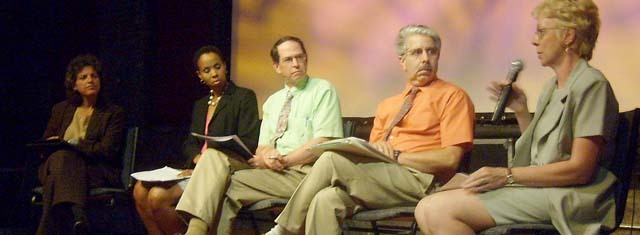
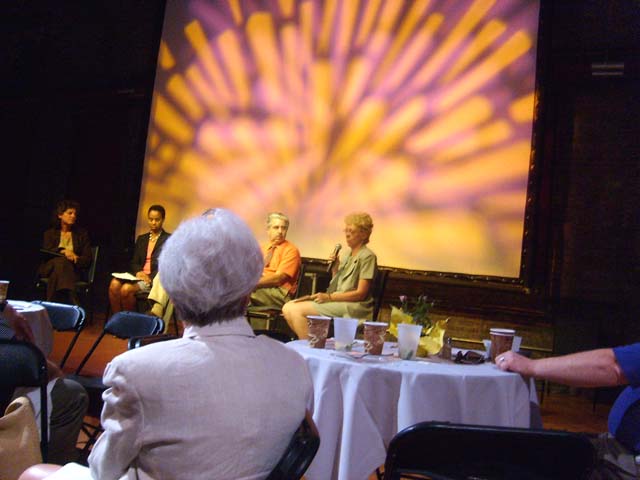 Moderator Maria Basescu, Dr. Lauren Smith, Dr. Douglas Karrel (not seen), Alan Bashevkin and Deborah Simmons discuss a health documentary at Mass MoCA last week. Moderator Maria Basescu, Dr. Lauren Smith, Dr. Douglas Karrel (not seen), Alan Bashevkin and Deborah Simmons discuss a health documentary at Mass MoCA last week. |
Louisville with its sharply drawn neighborhoods may have been the example for the series, but Northern Berkshire residents shouldn't think that those health inequities are absent here.
"I can personally attest to the elderly choosing between food and medicine," said Karrel. Even with the state's new health insurance reform, there's a gap between losing a job and getting coverage through Commonwealth Care. "I see people canceling appointments because they can't pay."
"I can attest that what we have seen tonight is not something that is unique to some part of another state but happens right here in Northern Berkshires," he continued.
Smith said viewing the documentary "crystallized" a lot of things she was seeing in her own hospital practice. It took her awhile to comprehend the low expectations of her patients, how parents would think two days of bad asthma was a reasonable level of health for their children.
"I have seen first hand in what was discussed in theoretical ways at some points in the film," she said, which is how social factors outside the hospital end of making people sick, keeping them sick or make it harder for them to get well."
One of those social factors was the level of chronic stress that occurs at every economic level. However, the lower you move down the socioeconomic ladder, the higher and more constant the stress level. The less control you have over your life, the more debilitating the stress.
Researchers now believe that chronic stress increases the risk of a range of diseases, including obesity, diabetes, hypertension, heart and artery disease. It also may have long-term effects on children's ability to adapt and learning skills.
Karrell said he's seen the degree to which stress can play havoc on health of those from lower socioeconomic backgrounds. He's even more concerned about what's not known.
Smith said the low expectations of her patients were compounded by their social setting - their neighbors, family and friends were also often battling illness, in this case asthma. "They actually thought that consistent asthma was as good as it gets."
While agreeing that the root of poor health lies in socioeconomic status, the solution is complex because so many factors have to be taken into account.
Deborah Simmons of Reach Community Health Foundation, an arm of Northern Berkshire Healthcare, gave the example of smoking — a significant health issue in Northern Berkshire because some 35 percent of births at North Adams Regional Hospital are to women who smoke.
Reach has a smoking-cessation program that has tried to connect with young mothers. But when the coordinator does home visits, she finds smoking is the tip of the iceberg.
"They typically don't have the money to buy diapers, food," said Simmons. Added to that, they often struggle with housing and financial instability, and the program loses track of them. "And, in fact, smoking is a stress reliever. How do you get beyond that when they have these huge stressors in their lives?"
A single adult with an infant and a preschooler would have to make $22.86 an hour, more than $48,000 a year, to be self-sufficient in North Adams, said Alan Bashevkin of Northern Berkshire Community Coalition. The calculation is based on the Crittenton Women's Union survey, which looks at basic needs for self-suffiency.
Yet, he said, the median income in 1999 was $27,601 in North Adams; 2007, the average annual wage was $37,284. "The wages that we have supporting people in Northern Berkshires doesn't really do it."
The first step in overcoming these inequities is to accept that they exist, said Bashevkin. People often don't have the ability to change jobs because they don't support their lifestyle; factors like transportation, child care, housing and raising children affect decisions.
He said his organization reaches across neighborhoods and social boundaries; Simmons said hers sponsors outreach programs across a wide range of prevention issues.
"I'm suggesting we take a look at the silos we're working in to break down the barriers to work together," she said.
 Smith said it was a matter of looking at social factors as health issues and getting out of the health deliver mode. It isn't enough to tell people what they need to do to be healthy but to ensure they have the ability to implement it. If you tell people to eat healthy, can they get to the supermarkets? she asked.
More importantly, socioeconomic factors have to become part of health policy and ensuring citizens basic needs are met.
"I really think what makes more sense is keeping it from happening in the first place," said Smith, who was "thrilled" that so many locally were cognizant of those factors. "I can assure you that the nonrandom, unhealthy choices ... that's something we can change."
Wouldn't it be nice, said Karrel, if the measure of success was not having the biggest house, or car, or bank account but "was based on our ability to care."
"Health care requires more than bricks and mortar, more providers and more technology, but also economic policies that foster better schools and housing."


