
Independent Investor: Where Have All the Flowers Gone?
 |
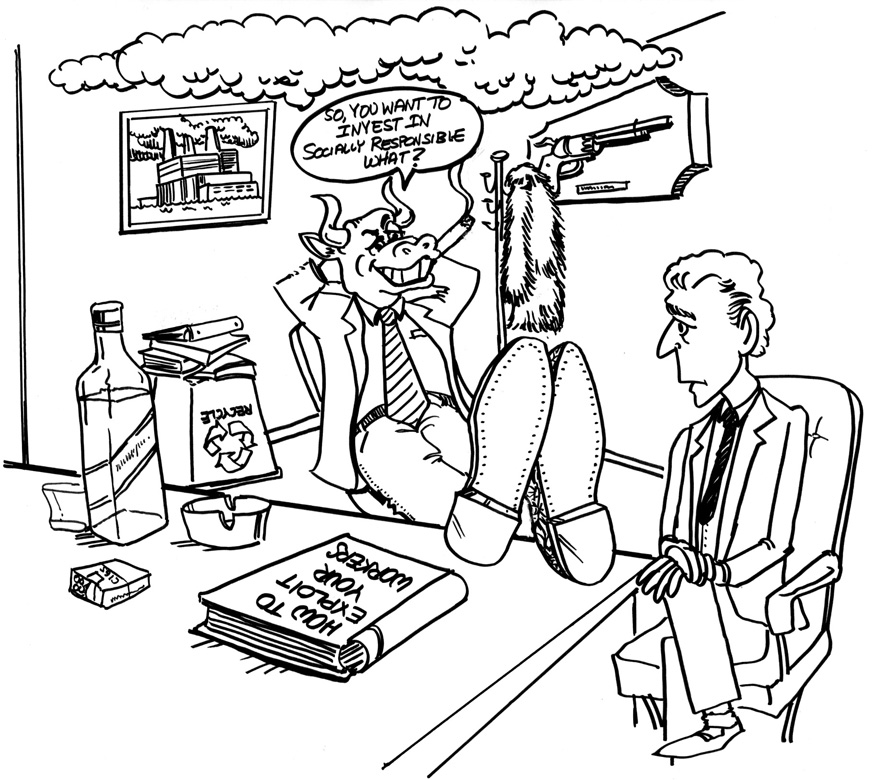
That runs contrary to its detractors who believe SRI, the investment strategy of combining financial return with social good, is an idea of the lunatic fringe. I disagree.
Social investing in this country has been around since the Quakers first forbid their members from buying and selling slaves. John Wesley, one of the founders of the Methodist Church, also preached on the pious use of money. Modern SRI began when investors shunned Dow Chemical (among other companies) as a protest against the use of napalm and profiteering during the Vietnam War. Since then, nuclear power, auto pollution and a host of other causes have galvanized the movement.
By some estimates there are now between 1 million and 2 million Americans who, in varying degrees, attempt to steer clear of "sin" stocks. A partial list of targeted areas would include: tobacco, gambling, alcohol, defense, environmental, human rights, labor, abortion and animal rights.
That might not sound like much but if you count institutional investors, like pension funds and other corporate activists, the total investment in SRI exceeds $2.7 trillion dollars or 11 percent of the $25 trillion in total assets under management in the U.S. today. That means that nearly one out of every $9 is invested today with an idea of righting some wrong whether in Darfur, Zimbabwe or anywhere in between.
The largest pool of such money, about $171 billion, resides in the 173 different SRI mutual and exchange-traded funds including $12 billion in variable annuity products. There are also three closed-end funds and 46 alternative investment vehicles that hawk the latest in "going green." So how have they really performed this year?
 It just so happens that I have a few clients who have asked me to invest them in some SRI funds. At Dion, we use several exchange traded funds (ETFs) from time to time that also qualify as "green" funds. Two mutual funds, I have used, Pax World Balanced (up 0.5 percent) and New Alternatives (down 2.5 percent), were purchased in early September of last year and are down less than 3 percent while Guinness Atkinson, an alternative energy fund, is down about 6 percent from the October 2007 market peak. There are also two SRI screened ETFs: KLD and DSI.
These securities shadow the Domini 400 Social Index, which is a socially-screened index of market cap-weighted common stocks. This index is off 82 cents for the year, which is doing better than its cousin, the S&P 500.
There are other exchange-traded funds that attempt to replicate alternative energy which are much more volatile. For example, Powershares Cleantech was down as much as 19 percent but has recovered to a 2 percent loss for the year. Power Shares Water Resources, after falling more than 9 percent, is now showing a 1.6 percent gain year-to-date.
WilderHill Clean Energy has lost a whopping 19.28 percent year-to-date. Obviously some funds can offer investors a wild ride. Buyers beware, much of any individual SRI fund's performance depends on the fund manager just like any mutual fund.
"Alternative energy funds have had a bigger correction," agrees Doug Wheat, a Florence fee-only financial planner with some SRI clients. Doug worked for the SRI World Group, an information provider on socially responsibility and corporate responsibility before starting his own business.
He believes there is a shift afoot among SRI managers. In the past, managers screened and selected companies based on what they didn't invest in, like tobacco or alcohol.
"Today there is a trend toward sustainability investing," Wheat said. "Firms are shifting from a negative to a more positive, forward-looking approach.’
He said managers are screening for companies that take an aggressive, proactive approach toward good corporate citizenry. Now, experienced pros feel they have an inside track on how company managers perform in this area and can use that knowledge to invest in the winners and avoid the losers.
Finally, among this generation's SRI investors priorities and concerns have changed. Alcohol and gambling, for example, have taken a back seat to global warming, carbon pollution and human rights.
The point to remember is that there is an up-and-coming next SRI generation. More and more people and institutions are investing with their heart as well as their pocketbook. Thanks to them, the flowers will still be around this summer and, hopefully, for many more summers to come.
Bill Schmick is a licensed investment adviser representative and portfolio strategist with Berkshire-based Dion Money Management, managing more than $800 million for middle-class Americans from coast to coast. Direct your inquiries to Bill at 1-877-850-7942, Ext. 146, (toll free) or e-mail him at wschmick@dionmm.com. You can also visit www.afewdollarsmore.com for more of Bill's insight.


