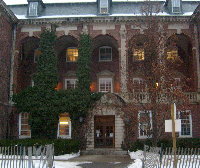
WILLIAMSTOWN - Williams College's collection of rare documents of the nation's founding will be moving to a temporary home soon.
The Chapin Library, where the Declaration of Independence is exhibited, will close Jan. 1 in preparation for the estimated $55 million expansion of Stetson Hall.
The archives and special collections in Stetson will be packed up and the bulk stored at the college's off-site shelving facility being built at the former Berkshire Ivy Gardens property on Simonds Road. The Declaration and other historic documents will be exhibited at the Williams College Museum of Art during the three years of construction on the new facility.
College Librarian David Pilachowski said a relatively small, "working" portion of the archives will be available at the former Southworth School, which is used as housing by the college. Several vacant apartments will be used for storage, offices and a reading room that will be ready by the fall semester.
"Then, in 2011, we will return about 75 percent of the Chapin and archive collections to the new library building," said Pilachowski on Friday.
They will return to an airy, five-story, glass-enclosed library and technology center being built on the back of historic Stetson Hall. The new structure will replace the increasingly obsolete Sawyer Library, which will remain open during the construction.
In a recent presentation to the college community, Pilachowski said, "what we've tried to do is make a building that's very logical, to make the building people-friendly."
The layout of Sawyer and the accumulation of books and other resources were pushing the people who use the library out of the picture, he said. The new building is designed to address Sawyer's "chopped up" collection and make the library more efficient and user-friendly.
Pilachowski was joined by architects from the building's designer, Bohlin Cywinski Jackson, including Russell Roberts, principal of the project, and Lee Clark.
Instead of being faced with the daunting stairway entrance of Sawyer, the new building will be entered through a soaring atrium on the first floor of Stetson, leading into the new space past a circulation area.
Four stories will include a consolidation of the college's information technology services, meeting, classroom and study areas, a cafe and computer labs. The fifth floor will basically be a seating balcony overlooking the fourth-floor, described as the "catbird" seat for readers seeking privacy and a great view out the floor-to-ceiling windows.
Utilities, elevators and restrooms will be placed in a core area running parallel to Stetson. The archives and special collections will be situated in Stetson and in the new structure. Nearly half the second floor will be used by the Center for Media Initiatives, which offers computer, printing and multimedia services.
The building will take advantage of the steep slope behind Stetson to keep its profile low relative to the older building. While the building's back, or east, glass-fronted face will be dramatic, the architects have tried to keep its front face from overpowering the 1923 Stetson Hall.
The approximately 180,000 square-foot structure would extend out from either side of Stetson, farther on north side than the south. From the perspective of someone walking toward the entrance, the south side would almost disappear, lessening the visual impact.
The front exterior of the new building will likely be faced with green slate and the "core slice" extending beyond it, with brick.
"There seems to be wide support to use the grey-green slate," said Pilachowski on Friday.
The three-decade old Sawyer will be demolished to create an open space linking the new Paresky Student Center to Stetson and the two new office and classroom buildings that frame the Stetson entrance. Those buildings are now under construction; the entire project is estimated at about $128 million.
The facility on Simonds Road, expected to be completed in May, will be used to store much of the college's periodical and government documents collections after the new library is completed.
"The next step is for the architects to do detailed drawings," Pilachowski said. Cost estimates will based on those drawings. The college will review the estimates and make changes where necessary before the final plans are approved, he said.
Construction is expected to start by next fall. For more information, http://library.williams.edu/newlibrary/
If you would like to contribute information on this article, contact us at info@iberkshires.com.
Your Comments
iBerkshires.com welcomes critical, respectful dialogue. Name-calling, personal attacks, libel, slander or foul language is not allowed. All comments are reviewed before posting and will be deleted or edited as necessary.
No Comments
Williamstown Planning Board Narrowing in on Subdivision Bylaw Changes
By Stephen DravisiBerkshires Staff
WILLIAMSTOWN, Mass. — The Planning Board late last month discussed specific features of what it plans to pass as a new subdivision control bylaw this year.
The board long has discussed the complex set of regulations as being out of date and cumbersome to both potential developers and the board itself, which has needed to hear requests for waivers of outdated rules for the handful of residential subdivisions that have been proposed in town in recent years.
This spring, the town engaged consultants from Northampton's Dodson and Flinker Landscape Architecture and Planning to go through the existing bylaw, compare it to more contemporary regulations in other communities and help craft a revised bylaw.
Unlike the zoning bylaw, where amendments require approval of town meeting, the subdivision control bylaw is a creation of the Planning Board, which can make changes on its own after a public hearing process it hopes to complete this year.
At a special Planning Board meeting on May 26, Dillon Sussman of Dodson and Flinker and his colleagues walked the board through a dozen different decision points that the board must resolve — either by leaving the bylaw as is or making a change — and offered suggestions based on best practices.
All of the issues are technical and ranged from the fundamental, like how the bylaw will define types of subdivisions, to the highly specific, like what turning radii will be required in new streets that are constructed to serve planned developments.
One example of a topic that came up in the recent approval of a four-home subdivision off Summer Street is stormwater management.
Cassidy Flynn scattered five hits in a complete-game effort in the circle as Lenox upset top-seeded Hoosac Valley, 3-2, in the quarter-finals of the Division 5 State Tournament. click for more
Brayden Durant struck out seven and walked one in a complete-game effort on the mound Saturday to pitch the Drury baseball team to a 6-0 win over Keefe Tech in the quarter-finals of the Division 5 State Tournament at Joe Wolfe Field. click for more