
Pianist Seymour Lipkin at Williams College
 |
These free events are open to the public and do not require tickets.
Listeners of this concert and participants in Mr. Lipkin’s master class have the rare opportunity to share the music of a man whose career and experience encompass an entire era of classical music. It is difficult to say what aspect of his life’s work is most remarkable or most impressive: his work as a concert pianist, having performed, for instance, with the major symphony orchestras of Boston, New York, Cleveland, Philadelphia and Chicago, or as an educator presently with the Curtis Institute and Juilliard, or as a conductor serving as the New York Philharmonic's assistant conductor, and Music Director of the Long Island Symphony from 1963 to 1979, as well as the Joffrey Ballet company from 1966 to 1979.
It is customary to drop names when introducing an artist of this caliber and with these credentials, but Mr. Lipkin is one of the few musicians for whom this is not just a gratuitous exercise. A student of Rudolf Serkin and Mieczyslaw Horszowski at the Curtis Institute of Music, Mr. Lipkin won the prestigious Rachmaninoff competition at age 20. Conductors with whom he has collaborated include Serge Koussevitzky, Fritz Reiner, Charles Munch, Leonard Bernstein, Eugene Ormandy, William Steinberg, George Szell, and Christoph von Dohnanyi, and more recently with Kenneth Schermerhorn, Gerard Schwarz and George Cleve.
Extremely active in chamber music, since 1988 he has been artistic director of the Kneisel Hall Chamber Music Festival; he has performed with Jascha Heifetz (60 concert tour), Oscar Shumsky, Uto Ughi, Arnold Steinhardt, Aaron Rosand, William Primrose, David Soyer and Lawrence Lesser, and toured the U.S., Europe and South America with the Guarneri Quartet. He performed a ten city European tour with the Juilliard String Quartet in 1999 and appeared again with them at the Library of Congress in 2001. He has recorded sonatas with Shumsky, Rosand and Steinhardt (complete duos of Schubert).
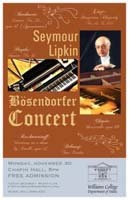
He performs in Chapin Hall on the 9’ Bösendorfer concert grand piano in a program that reflects his devotion to chamber music. Featured works include the Sonata in A-flat major, Hob. XVI/46 by Haydn, Beethoven: Sonata No. 23 in F Minor, opus 57, “Appassionata”, Chopin: Barcarolle in F-sharp Major, opus 60; Rachmaninoff: Variations on a theme by Corelli, opus 42, Two Etudes by Debussy, and Liszt: Hungarian Rhapsody No. 15 in A Minor, S. 244, “Rakoczy March”.


