
Windsor Man Always in Hot Water
 Photos by Noah Hoffenberg
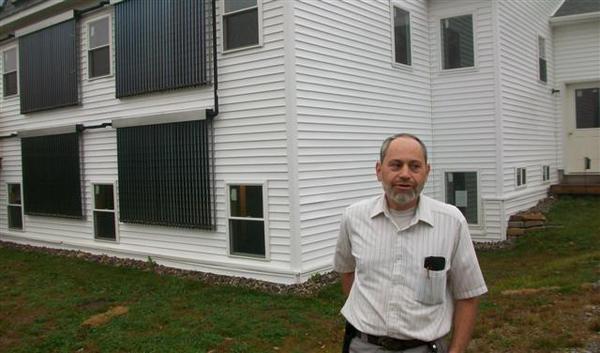
Stu Besloff's Windsor home is covered in glass tubes that heat water for home use, including his indoor pool.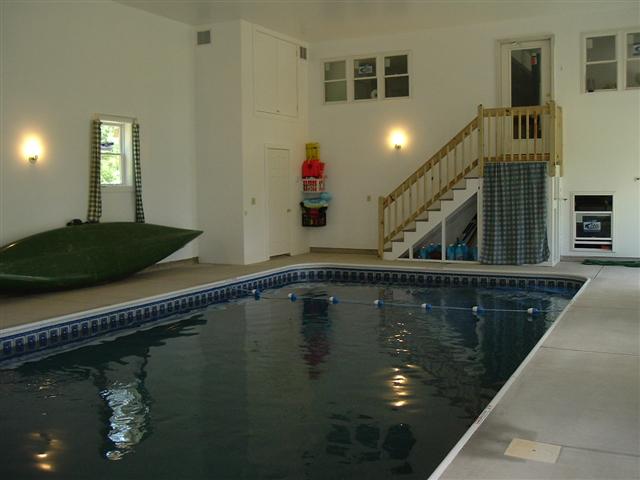 Pool photo courtesy Besloff.
|
Upon getting closer to 189 North St., it looks like large interior blinds have been set up all over the south side of his home. But blinds, they are not.
Besnoff — a Navy veteran, former Pittsfield High School teacher and scoutmaster in Windsor — has 34 solar hot-water collectors on his home. Each unit has 30 vertical tubes, for a total of 1,020 cylinders.
It's part business and part passion for Besnoff, who's been an advocate of alternative forms of energy for some 30 years ago. His company, Alpine Solar Heat and Hot Water, is one of the few in Berkshire County that sells this equipment, said Besnoff. (Heliocentrix in Williamstown offers a similar product.)
He opened his home-based business to the public on Saturday as part of the Green Buildings Open House Tour 2009, sponsored in part by the Center for Ecological Technology. The open house was designed to show Berkshire County residents how using green technologies can help reduce utility costs, increase conservation and generate surplus "green" energy.
Solar isn't for everyone, Besnoff said. But for those who can use it, the benefits are local and global.
"There's some houses where you just don't have a good site. If there are tall trees on a neighbor's land, you can't cut them down, or if there's skyscrapers, or you're in a valley, you don't have a good site for solar," said Besnoff. "But there are large numbers of houses that do have a good site for solar. If those people got [solar] domestic hot water, they would save money and cut down on our use of fossil fuel."
Rather than the more common photovoltaic panels, which are used primarily to generate electricity, Alpine Solar markets evacuated tube collectors, long glass cylinders that collect the heat of the sun and transfer the heat through water and nontoxic anti-freeze filled copper tubes to a series of holding tanks.
These tanks, much like the average hot-water heater, only larger, heat a potable source of water and
supply all of the heat and hot water to the house.
“
"I'm not producing electricity here. The energy that I collect from the sun is used for domestic hot water, heating the house and heating the swimming pool," said Besnoff, the latter referring to a large indoor pool at his home's ground level. "You have to work harder to get the energy out of sun, but you don't pay for it."
For consumers looking to buy these evacuated tube collectors, Besnoff provides the product and the know-how; the installation would come via an outside contractor, said Besnoff. Most plumbers can do the hot-water installation, said Besnoff, who holds bachelor's and master's degrees in engineering from Rochester (N.Y.) Polytechnic Institute.
While Besnoff's hot-water and heating setup is rather large, the average homeowner can get a system that's substantially smaller. It would actually work in concert with most existing hot-water systems, he said.
"Many people would benefit by doing only domestic hot water. You would use one of these," said Besnoff, gesturing to his several hot water tanks.
Heating your house would require more design work, said Besnoff. For domestic hot water only, a roughly $3,000 initial cost would be paid back in fuel savings after 10 years of use, Besnoff estimated. In many cases, a solar tank and system would act as a preheater for the existing tank, cutting heating bills dramatically.
Last winter, Besnoff used a wood-fired furnace for a total of 16 days with an average burn time of 3 1/2 hours. If it's partly cloudy, the sun still aids in heating his home, he said. He uses a little electricity and propane for cooking, but eventually wants to convert the home to zero-energy use.
Still a work in process, the house where Besnoff now lives serves as his home, office and demonstration model for Alpine Solar. The home can be shown by appointment.
"People need to be convinced because they don't see it much. What I offer here is the model home, the dissected pieces of the equipment ... so I'm trying to get people started," said Besnoff. "I'm doing my
part."
Find out more about Alpine Solar at www.alpinesolarheat.com or call 413-684-3950. The Center for Ecological Technology will also hold a talk, "Solar Energy for Homes and Small Businesses," on Wednesday, Nov. 4, at the Berkshire Museum, 39 South St., Pittsfield, from 6:30 to 8 p.m. Call 413-445-4556, Ext. 25, to register or for more details.


