
Local Lawmakers Warn of Education Woes
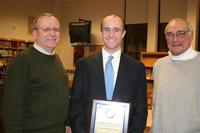 |
| Ex-MASC President Joseph Santos, left, and Herbert Abelow, chairman the Southern Berkshire School District, presented Sen. Benjamin Downing with a Legislator of the Year award. |
"Work in education comes with a lot of grief and not a lot of appreciation. We have to do more for our school districts of all sizes and the one common thread is that we, in state government, need to find more resources to direct to those districts," said Downing during a meeting of county school committees on Monday night at Nessacus Regional Middle School.
Facilitated by the Massachusetts Association of School Committees, the forum gave school officials the opportunity to question their representatives on their legislative priorities concerning education. Amid questions regarding the loss of state funding and fears about dwindling resources, Guyer warned of a tough road ahead.
"We know that money is tight and we know, here in Western Massachusetts, that we are fighting what I think is a losing battle," said Guyer, responding to criticisms of the current educational system that sends more money to schools with increasing enrollment and takes funds away from schools with declining enrollment.
That has helped burgeoning schools in the more urban eastern part of the state while rural schools in the west are being pinched as the population declines.
"As long as we have a system where the majority are rewarded by the current system and the minority are hurt, we're not going to see a lot of change," said Guyer. "Unless the districts in the (Interstate) 495 beltway start losing students precipitously, they won't feel our pain."
Guyer said the Education Reform Act of 1993, which funded schools on a per-pupil basis, does not benefit students in rural communities.
"Our children are suffering because of that reform. Their right to a good, quality education is being infringed upon," he said. "But there aren't enough of us fighting for this argument. We can't just close down schools, whether they have 30 students, 130 students or 330 students."
Losing students to charter schools also funnels money away from needy public schools, said Heather Williams, a Mount Greylock Regional School Committee member.
"If a student goes to a charter school, it takes money away from the district. Yet, when we get a student through school choice, it brings in little money," she said.
In response, Downing said the Legislature should look to find ways to equally distribute funds.
"It is an inequity. Charter to public, public to charter, their education should cost the same," he said. "Right now, we have a system where there are winners and losers instead of a sense of equity."
With Gov. Deval Patrick expected to unveil his budget tomorrow, Downing and Guyer said municipalities shouldn't expect an increase in funding for education. That despite a report released to the state Board of Education on Tuesday that said education spending is not keeping up with inflation.
"There's a $1.3 billion deficit and we have no clear idea what the revenue picture is supposed to look like," said Guyer.
While prospects for the future look bleak, representatives from the Southern Berkshire Education Collaborative (which includes the Berkshire Hills, Southern Berkshire, Lee and Lenox districts) said school districts could "do more with less" if the entire county united to create one Berkshire County Collaborative. Working together could cut costs by helping to create partnerships that allow for sharing resources and services.
Superintendents countywide are still considering the proposal but SBEC officials said they hope to see a collaborative formed this year.
The night also boasted a small awards ceremony for Downing, who was named MASC's Legislator of the Year at the event for his dedicated support to key educational issues. Former MASC President Joseph Santos presented Downing with the award and commended him for his commitment to helping the organization reach its legislative priorities.
"We had four requests - adequate and equitable distribution of Chapter 70 school aid, full funding for local and regional transportation, full funding of the special education circuit breaker and health-care options for everyone - and [Downing] has helped to move us toward all of these goals," said Santos.


