
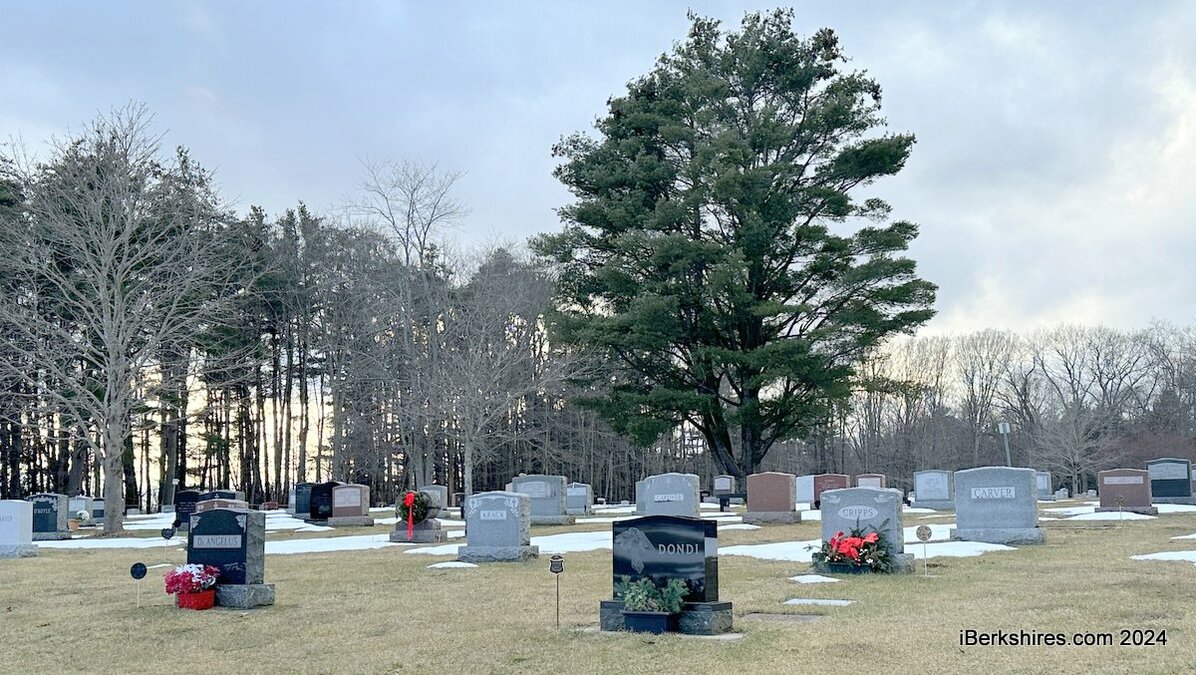
Dalton Considers Allowing 'Green' Burials
DALTON, Mass. — Residents may have the option of so-called "green" burials in the future.
Also referred to as "natural burials," green burials are a way of returning bodies to the earth after death without a metal casket, burial liner or vault, or embalming, according to the nonprofit Green Burial Massachusetts.
The cemetery trustees are still very early on in the process of establishing green burials. There are a lot of unknowns surrounding the service they need to explore first, the trustees said. This excludes someone who wants to be buried in their yard, which would be a separate process.
"It's gonna be a long process, though. It's gonna be a lot because the thing is, there's many things that we have to know before we actually do something like this," Chair Judith Douville said at the trustees' meeting last week.
Dalton has received some comments from residents expressing their interest in having this option available to them.
"And we just decided that it's something that a number of people want, but before we allow it, we just want to make sure we touch all bases," trustee Treasurer John W. Bartels Jr. said
They hope to be able to offer green burials for residents at the Ashuelot Cemetery but need to do so safely and prevent liability.
There also is perpetual care that needs to be considered because of the biodegradable materials; as the material and body eventually decays, there will be a depression in the ground that is a potential fall risk. Guidelines need to be put in place to cut down on liability.
Ashuelot Cemetery has a lot of open space that would allow a portion to be sectioned off and designated for green burials but this is dependent on various tests that need to be done on the solid and grounds.
One of the things that complicates green burials is diseases. The trustees are working with the Board of Health to clarify measures to prevent the spread of diseases.
The Board of Health last month reached out to the rare and infectious disease unit at Berkshire Medical Center in Pittsfield for guidance. At its meeting on Wednesday, board members said they need clarification on what a green burial is so that they can have a better idea of how to word the guidelines.
In addition, the members want to find out what their protocols are at funeral homes when someone presents with a communicable disease and what bodies are prohibited from being embalmed.
As long as the burial is happening within a cemetery, there isn't a problem because cemeteries have to go through certain designations to prevent groundwater from running off into waterways, board member Amanda Staples-Opperman said.
Despite this, the board agreed there needs to be a streamline guideline that determines which bodies are eligible for green burials.
"What's interesting is that the burial part isn't necessarily the most dangerous part. With a lot of these highly communicable diseases, they actually want the body in the ground as soon as possible," Staples-Opperman said
With some communicable diseases, such as ebola, the body "needs to be in two layers of leak-proof plastic and then in a hermetically sealed casket," she said.
Although these diseases are rare, the funeral homes should still have procedures in place in the case one presents itself.
Town counsel informed the trustees during a previous meeting that establishing green burials will be a dual effort between the two boards to come up with guidelines.
The Board of Health will be responsible for the "water table, settling water, decaying bodies, depth of graves, proximity to abutting properties," the meeting minutes said.
The trustees will be responsible for administrative matters such has the plot and lot size, monuments, planting, perpetual care, and interment allowed.
At this time it is unclear if green burials will need to be approved by town meeting but if they do, the trustees want to ensure they can answer any question that is presented to them by residents. This would not be ready by the annual town meeting in May.
Bartels also spoke to Ed Abrahams, a member of the Great Barrington Cemetery Commission when green burials were approved, to see what problems that board may have encountered during or following approval.
Cemetery Superintendent Edward "Bud" Hall will also attend a conference in March that has green burials as one of the topics, Bartels said.
The town will also need to communicate with cemetery staff to gauge if they are comfortable with doing this and accommodate their concerns.
The trustees started exploring this initiative in April when they were thinking about updating fees. Bartels brought the option before the board after noticing that Great Barrington approved green burials in August 2020.
Great Barrington is one of several dozen communities in the state that offers green burials, though it took three years to accomplish. Stockbridge, Mount Washington and the private Pine Grove Cemetery in Sheffield also allow natural burials.
It seems that each town approached establishing green burials in a different way, Bartels said, and there are not a lot of laws that specifically target green burials.
Tags: cemetery commission,


