
MCLA Forum Urges Women to Speak Out
 Journalist Janet Johnson Bryant spoke of the women's movement that ended the fighting in Liberia. |
Their experiences were chronicled in the documentary "Pray the Devil Back to Hell" by Gini Reticker and were the focus of the fourth Women's Leadership Conference at Massachusetts College of Liberal Arts. Some 60 women, including students, journalists, entrepreneurs, alumna and elected officials attended the luncheon and forum in Murdock Hall.
The forum's goal was to explore the ways in which women's voices and actions are changing conditions in the world and locally. For the women of Liberia, taking action meant risking lives as well, according to journalist Janet Johnson Bryant, who is featured in the documentary.
Bryant, reporting in Monrovia mostly with Catholic radio station Radio Veratis (Radio Truth), covered the rise and success of the Women in Peace Building Network, which started with a church group deciding the country's violence had to end.
"As a broadcast journalist, I felt it was my duty to expose the ills in my society. This included the war and its actors, corruption in government and human rights violations, among other issues," said Bryant, who is a recipient of a Profiles in Courage Award and is now pursuing a master's in international diplomacy. "I also encouraged the civilian population to speak out against the conflict."
Fighting in Liberia came to a head in the late 1990s between then President Charles Taylor's private army, feuding warlords and the use of boy soldiers to rape, torture and murder families and entire villages. WIPNet brought nearly 14 years of civil strife to an end in 2003 after less than two years of protests, marches in Monrovia and during the peace conferences in neighboring Ghana. In fact, the women at one point refused to let the factions leave the hall because of the slow pace of talks.
Yet, Bryant said, the movement that brought Christian, Muslim and other Liberian women together was rarely shown to the world outside.
"In Africa, culturally, people don't pay attention to what women do," said Bryant. Even her own editors would often ignore women's stories. The women reached out to her because she was in a position to let their voices be heard.
 |
Yet she refused to give in to frustration. "I do not allow myself to be frustrated, no matter the situation," she said. "What others see as frustrations I see as challenges and I always like to overcome challenges ... don't allow yourself to be beaten down."
Bryant was joined on the panel by Amber Chand, founder of the Women's Peace Collection and Prosperity Candle Co., which support women's enterprises in regions in turmoil; Shirley Edgerton, director of Berkshire Service Group, which provides residential services for adults with developmental disabilities; and Monique Symes, an MCLA junior who founded the college's winning step squad Nexxus and former teacher of the community step squad Step Alive. Both squads peformed at the beginning of the forum.
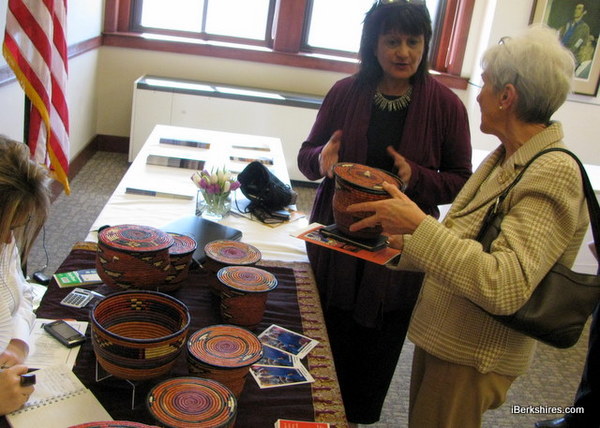
Chand's family became refugees when they were expelled from Uganda in the 1970s. She found her mission after a trip to Rwanda in 2003 after watching Hutu and Tutsi women come together to share in the weaving of baskets.
Now, she provides a way for women Third-World regions to work together and support their families — from refugee camps in Darfur to Guatemala to Israel and Palestine — through the sales of handcrafted articles.
"I see opportunity in chaos," said Chand, who added she feels like an instrument for something greater. "I have such a strong connection to divinity. Even in a dark place there is light; it's my purpose to find that light."
It made her angry, she said, when women are ignored, when women's speaking out is labeled in a negative way.
Edgerton said it was imperative to have allies, to connect with not only women but with men in other organizations. You also don't have to go halfway around the world to help others, she said.
 Bryant, left, Amber Chand, Shirley Edgerton and Monique Symes. |
"Experience is universal ... We know there's a purpose for each on of us," said Edgerton. "Find your passion and do your part."
Symes found hers by accident, she said. Her love of step in high school (fed in part by anger at the images of women in music) increased her confidence and led her to start teams here and then become involved with volunteer programs in the community.
"Everybody is a social worker ... something always needs to be done," she said, including mentoring the next generation. "I owe homage to everybody on this panel for being a symbol."
MCLA President Mary Grant summed up the forum by saying despite the dark things being talked about during the forum the future is brighter because of the young women — and young men — today who want to make a difference.
"As a young woman going into the future, I just got a powerful tool to use to motivate myself and keep believing in myself," said MCLA sophomore Hawa Umarova. "To continue to believe in my strength."


